Where fly agaric grows in Canada - shield, mountains and coast
A habitat map for Amanita muscaria: the trees it partners with, the ground it likes, the two-week window when the red caps rise, and the corner of British Columbia our own caps come from.
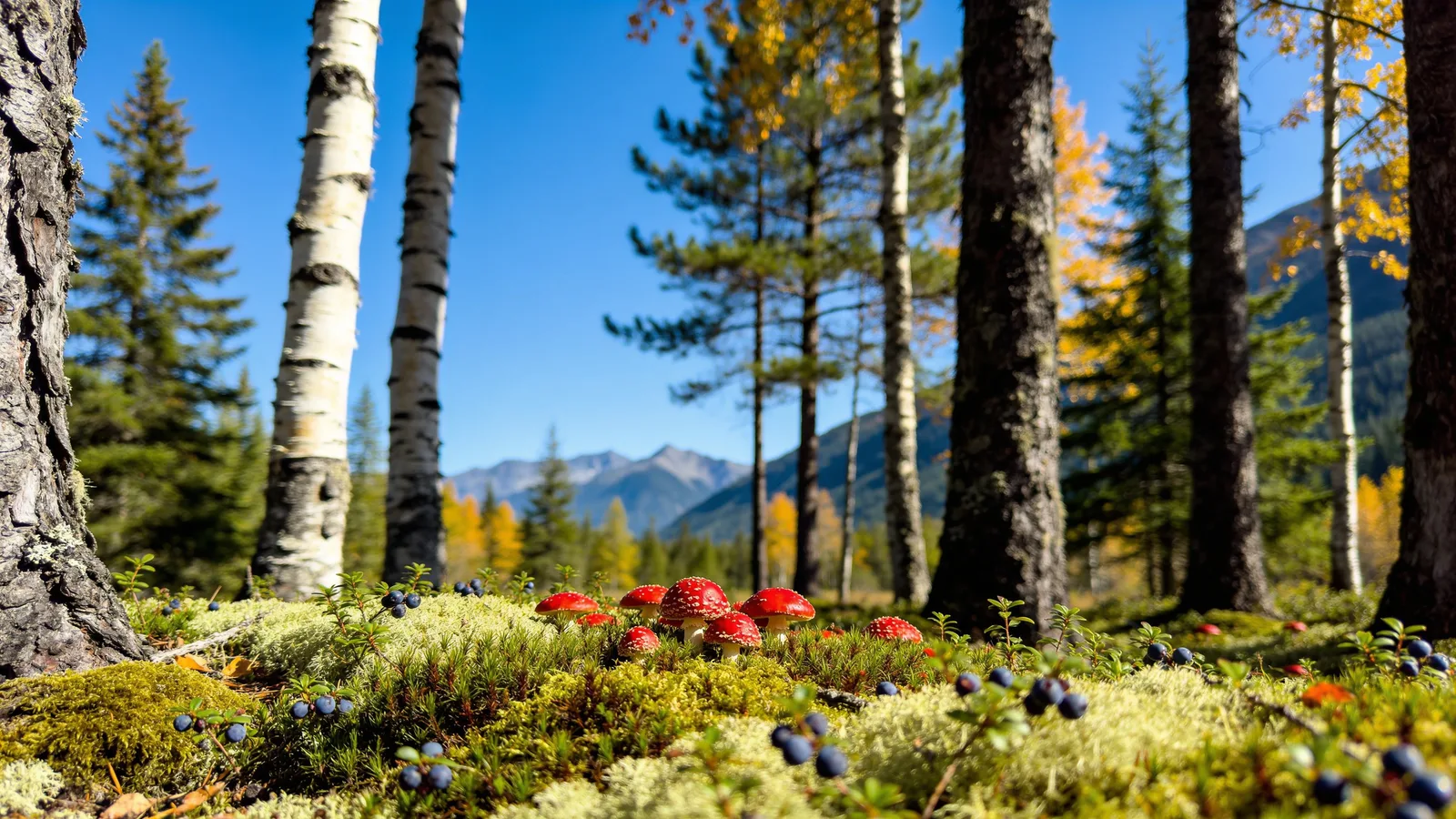
Wild Amanita muscaria in a mixed birch and spruce forest in British Columbia, where ShroomsBloom picks its dried fly agaric caps
TL;DR
- Amanita muscaria grows across Canada wherever its partner trees do, birch, pine, spruce, aspen, Douglas fir, and is common on the Boreal Shield, the granite-and-forest belt that curves from the Prairies to the Atlantic.
- It is mycorrhizal: bound to living roots, never found on dead wood or bare ground away from a host.
- The flush is short - often two to three weeks after the first cold, moist nights, roughly late August to early October.
- Our own caps come from a different part of the country entirely: the Coast Mountains of British Columbia, in the Sea-to-Sky north of Vancouver.
- Botanical specimen · not for consumption · 19+.
The rock under the forest
The Boreal Shield is Canada’s largest ecozone: a vast apron of ancient Precambrian granite, scraped bare and then re-dressed by the last ice age, arcing from northern Saskatchewan and Manitoba across Ontario and Quebec to Newfoundland. Thin acidic soils, ten thousand lakes, and a forest of black spruce, jack pine, white birch and trembling aspen. It is not lush country. It is patient country, and patience is exactly what the fly agaric is built for.
This is where most people picture the Canadian red cap, and they are not wrong. Moss over rock, spruce closing overhead, birch catching the low light at the edges. The caps are not scattered at random through it. They are wired into it.
Why it grows where it grows
Amanita muscaria cannot feed itself from dead matter the way a mushroom on a log does. It is mycorrhizal: its mycelium sheathes the fine roots of living trees and trades with them. The fungus hands over water and scarce minerals mined from thin soil, and the tree pays in sugars from photosynthesis. On the shield its partners are the keystone trees themselves, birch and spruce above all, pine and aspen close behind.
That partnership is the whole habitat map. Find a birch stand on mossy, well-drained ground near water and you have found the fly agaric’s address. The field guide tells you how to read the mushroom itself, and the collection is where a finished specimen ends up. Walk onto bare rock or into a dense dead-shade stand with no host roots and you will not, cannot, find it there. The mushroom is a symptom of a healthy root network you cannot see.
Our own ground: the Coast Mountains
Here is the part where our own operation stops matching the postcard, and we would rather say so than let the word “boreal” do work it has not earned.
We pick in the Coast Mountains of British Columbia, in the Sea-to-Sky country north of Vancouver, around 50 degrees north. That is not the Boreal Shield. It is not even close: the Shield stops well east of the Rockies, and this is Pacific Maritime country, the wet coastal belt that runs up the edge of the province. There is no Precambrian granite apron under our boots and no ten thousand lakes. There are steep valleys, a great deal of rain, hemlock and Douglas fir closing in overhead, and moss deep enough to lose a boot in.
The trees change, so the partnerships change. Instead of jack pine and black spruce it is western hemlock and Douglas fir, with paper birch along the valley bottoms and the roadsides, and pine and spruce where the ground rises. The fly agaric takes all of them. That is the useful thing about this species: it is circumpolar and not remotely fussy, so it comes up under the trees of a wet coastal valley just as readily as under the birches of a dry granite shield, wearing exactly the same red.
The season behaves the same way too, which is the other reason the two places belong in one article. Cold nights, steady wet, and then a fortnight of caps.
The window
Fruiting is a response, not a schedule. Through spring and summer the fungus lives entirely underground as mycelium. Then the trigger arrives: the first cold nights of late summer, paired with steady moisture. Within days the colony pushes up its fruiting bodies, first as pale white “eggs” wrapped in the universal veil, then splitting to reveal the red as the cap expands and the white warts scatter across it.
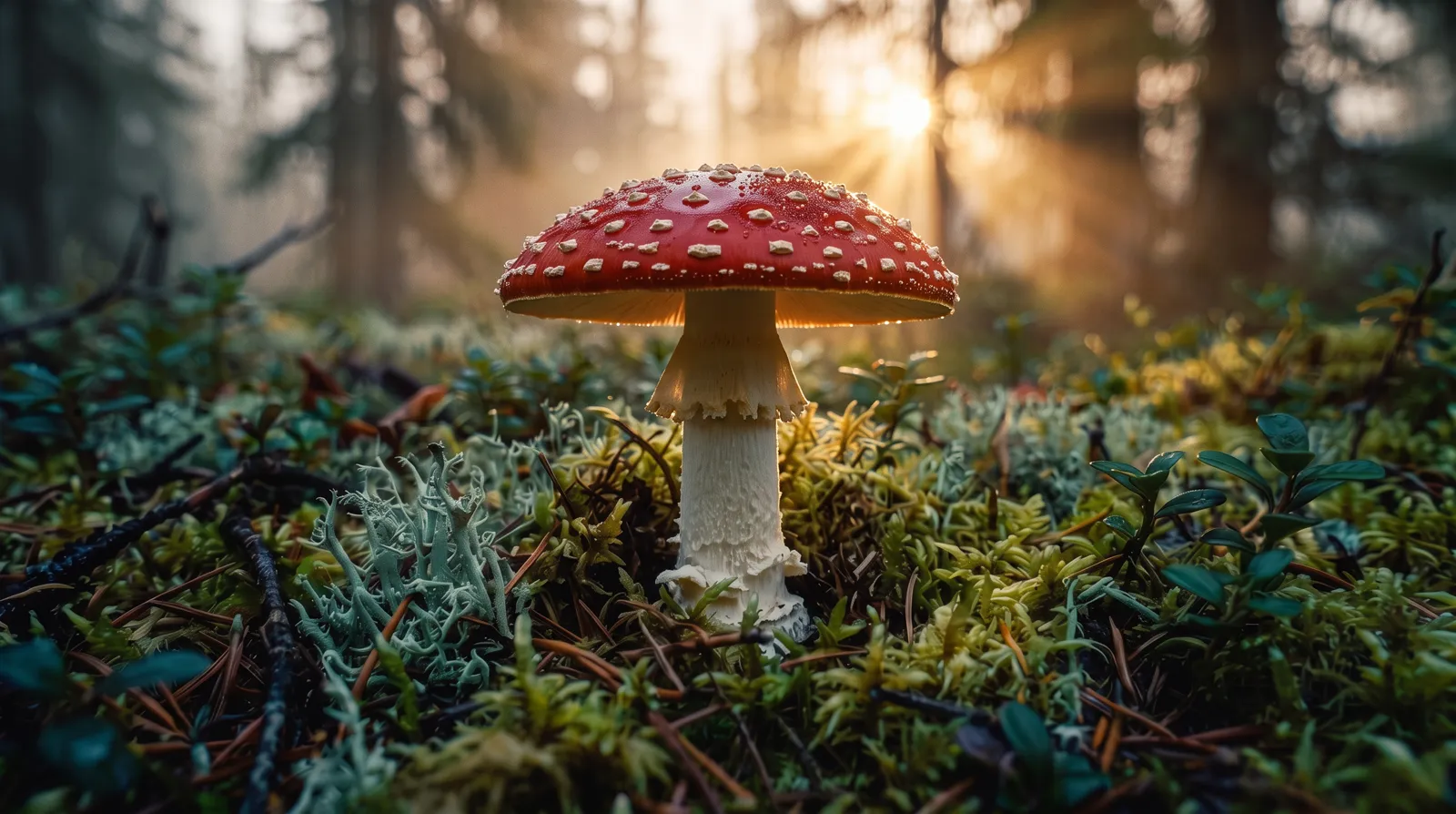
The flush is brief. A given site may show caps for only two to three weeks, somewhere between late August and early October depending on latitude, elevation and the year’s weather. Miss the cold snap and you miss the year. This is why the film is shot at 04:00, in the blue hour before a specific dawn: the window is not just seasonal, it is daily.
Reading the ground
A few habitat tells, if you want to recognize fly-agaric country:
- Host trees within a stone’s throw, birch, spruce, pine, aspen, and in the west Douglas fir and hemlock. Always check what is rooted nearby.
- Moss and thin acidic litter, well-drained, often on slightly raised ground between wet hollows.
- Forest edges and trailsides, where roots, light and moisture meet.
- After the first cold rain, not in the dry heat of midsummer.
None of this is a foraging licence. It is a way of understanding what you are looking at, and of picking with the colony’s future in mind. Provincial and national parks are closed to picking of any kind, and that is not a technicality: it is the single rule most people manage to break by accident.
One cap, colony intact
When we gather a specimen, the habitat sets the ethics. A single cap is one fruiting body of an organism that may spread for metres underground and live for years; taking it no more harms the fungus than picking an apple harms the tree. So we take one, brush the needles off on the spot, and leave the rest, the mycelium, the eggs still veiled, the partnership with the birch, exactly as we found it. The forest keeps its voice down. We keep it that way.
Botanical specimen · not for consumption · 19+. This article describes habitat for study; fresh Amanita muscaria is toxic - a raw cap is loaded with ibotenic acid, which careful drying and curing convert largely into muscimol.
Questions, answered
Where in Canada does Amanita muscaria grow?
Across the boreal and mixed-wood forests of nearly every province and territory - anywhere its host trees grow. It is common on the Boreal Shield ecozone that arcs from the Prairies through Ontario and Quebec to the Atlantic, and equally at home in the western mountains and along the Pacific coast.
Where does ShroomsBloom pick?
In the Coast Mountains of British Columbia, in the Sea-to-Sky country north of Vancouver. That is Pacific Maritime country, not the Boreal Shield: wetter, greener and much steeper, with hemlock and Douglas fir overhead instead of jack pine.
What trees does it need?
It is mycorrhizal with birch, pine and spruce, and in the west with Douglas fir, hemlock and aspen as well. No host tree, no fly agaric - it cannot live on dead wood or open ground alone.
When is the season?
Late summer into autumn, triggered by the first cold nights and steady moisture - often a tight two-to-three-week flush per site, usually somewhere between late August and early October.
Does ShroomsBloom harvest wild populations responsibly?
We take single caps and leave the colony and its mycelium intact, the way the film shows. The specimens are for collection and study only - botanical, not for consumption. 19+.
Sources & further reading
Keep reading
botanical specimen · not for consumption · 19+