The mushroom and its names
Carl Linnaeus described this mushroom in Species Plantarum in 1753 as Agaricus muscarius; Jean-Baptiste Lamarck moved it into the genus Amanita in 1783, giving us the binomial still in use: Amanita muscaria. It sits in the family Amanitaceae, order Agaricales - the same genus that contains both prized edibles and the deadliest mushrooms known to science, which is the single most important fact about it for anyone standing in a forest.
The epithet muscaria comes from the Latin musca, a fly. Not because the mushroom attracts flies, but because for centuries European households crumbled a cap into a saucer of sweetened milk to stun them - a practice recorded by Albertus Magnus in the thirteenth century and preserved in the common name of almost every European language. English says fly agaric. German says Fliegenpilz. Russian, Ukrainian and Polish say мухомор / muchomor - literally fly-death. French says amanite tue-mouches, the fly-killing amanita. Dutch says vliegenzwam.
Other names run in a different direction entirely. German also calls it Glückspilz, the lucky mushroom, and puts it on New Year cards beside chimney sweeps and four-leaf clovers. The same object is poison and good fortune depending on which century and which drawer of the culture you open, and that double life is the thread running through everything below.
Anatomy of a fly agaric
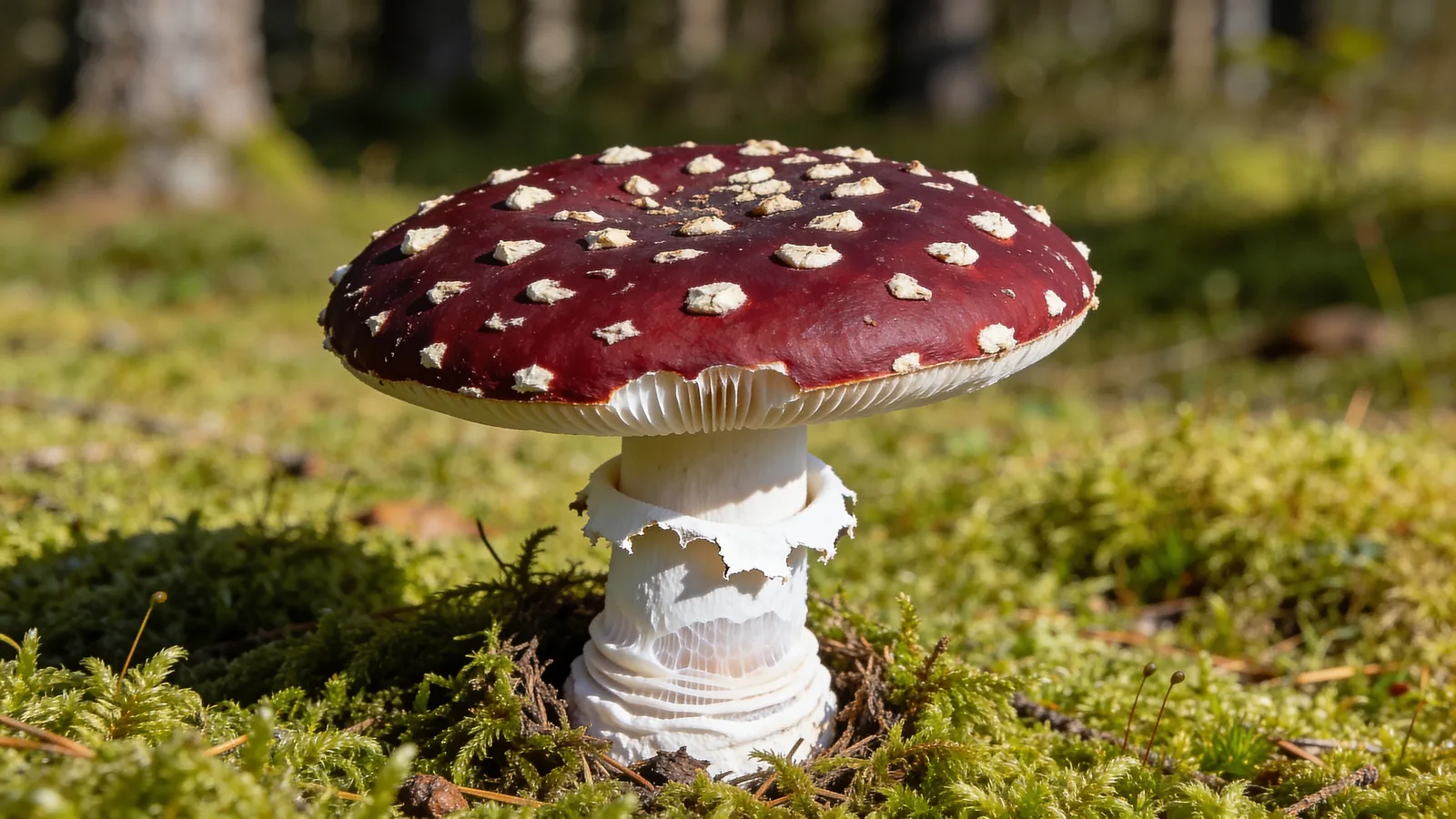
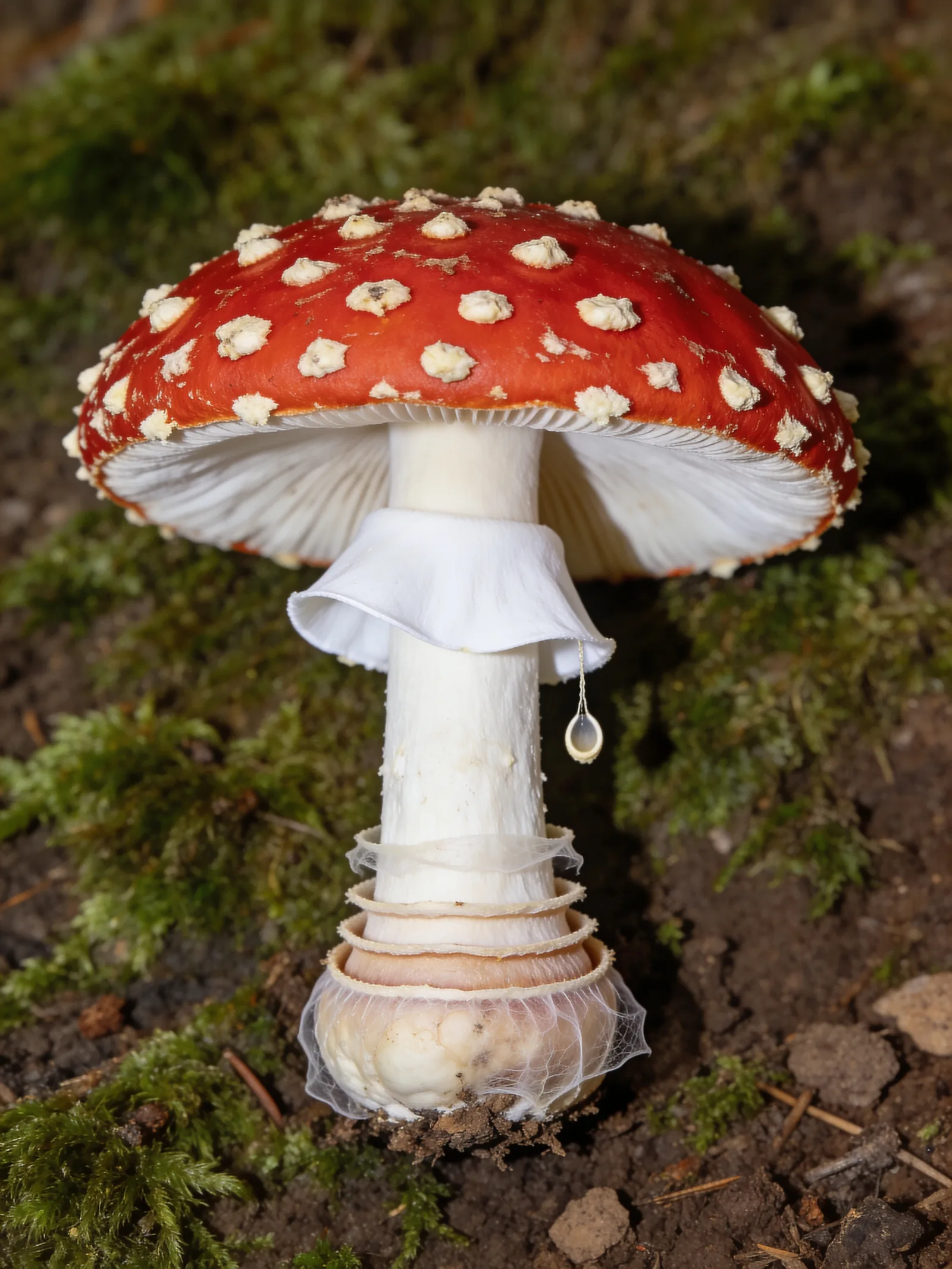
A fly agaric begins life underground as a white egg, wrapped in a universal veil. As the cap expands it tears that veil apart, and the fragments left stranded on the cap surface are the famous white warts. They are not part of the cap - they sit on it, and a hard night of rain will wash a cap clean, leaving a plain scarlet dome that fools people every autumn.
Underneath: free white gills that do not touch the stem, and a white spore print - the two characters that place it in Amanita and the two that matter most for identification. The stem carries a skirt-like ring (the remains of the partial veil that covered the young gills) and swells at the base into a bulb ringed with concentric bands of veil tissue, rather than the deep sac-like volva of its deadly relatives. Caps range from a thumbnail to the width of a hand; ours run from roughly 1 g to 30 g dried, which is why a pouch of dried caps is always a mixed, natural set rather than a uniform count.
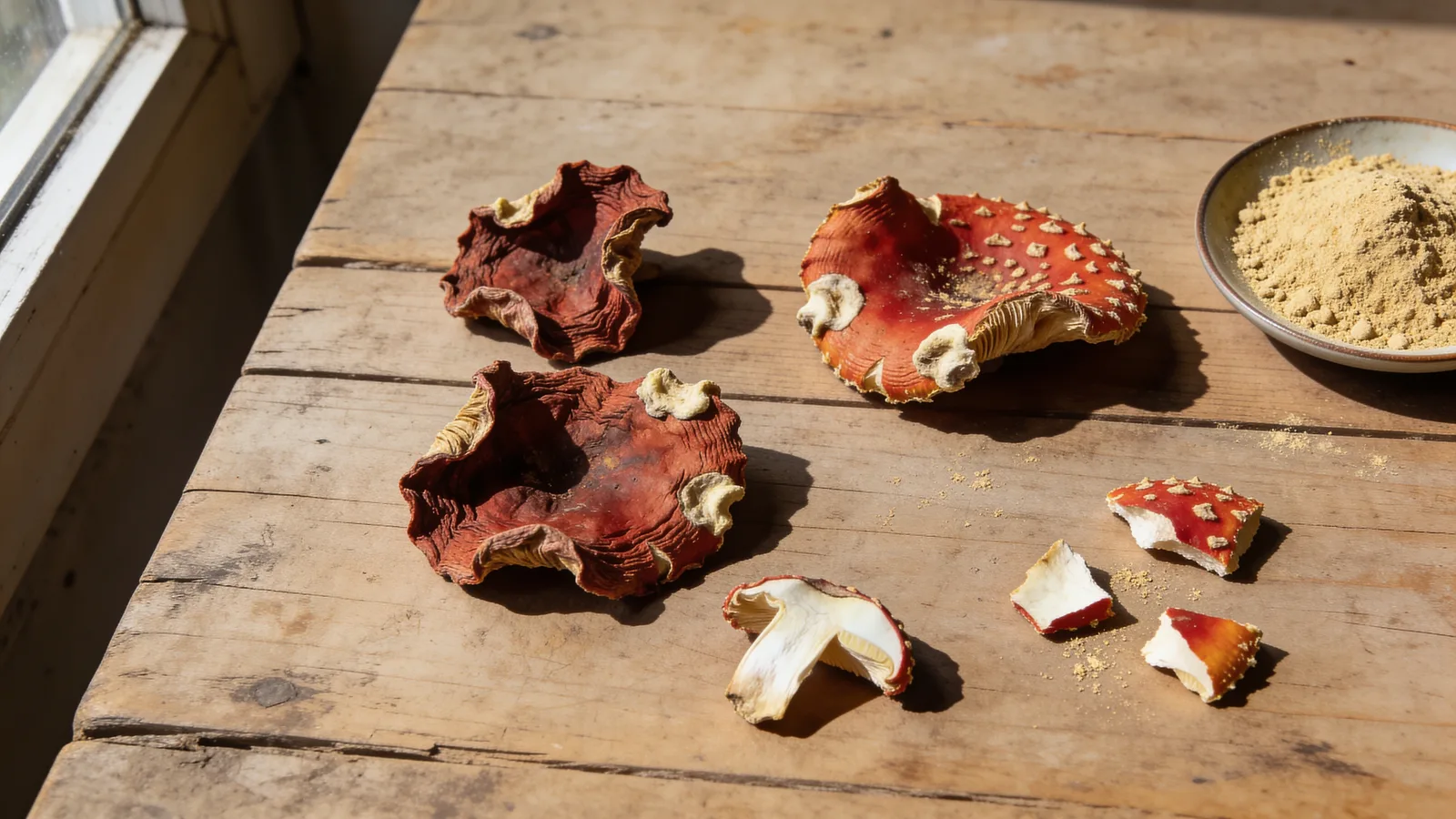
The colour is not in the flesh. It sits in the cap skin, and it is the first thing careless drying destroys: overheat a cap and the scarlet turns liver-brown, which is why every properly dried specimen you meet is still red. That is a quality test you can run with your eyes.
Why it cannot be farmed
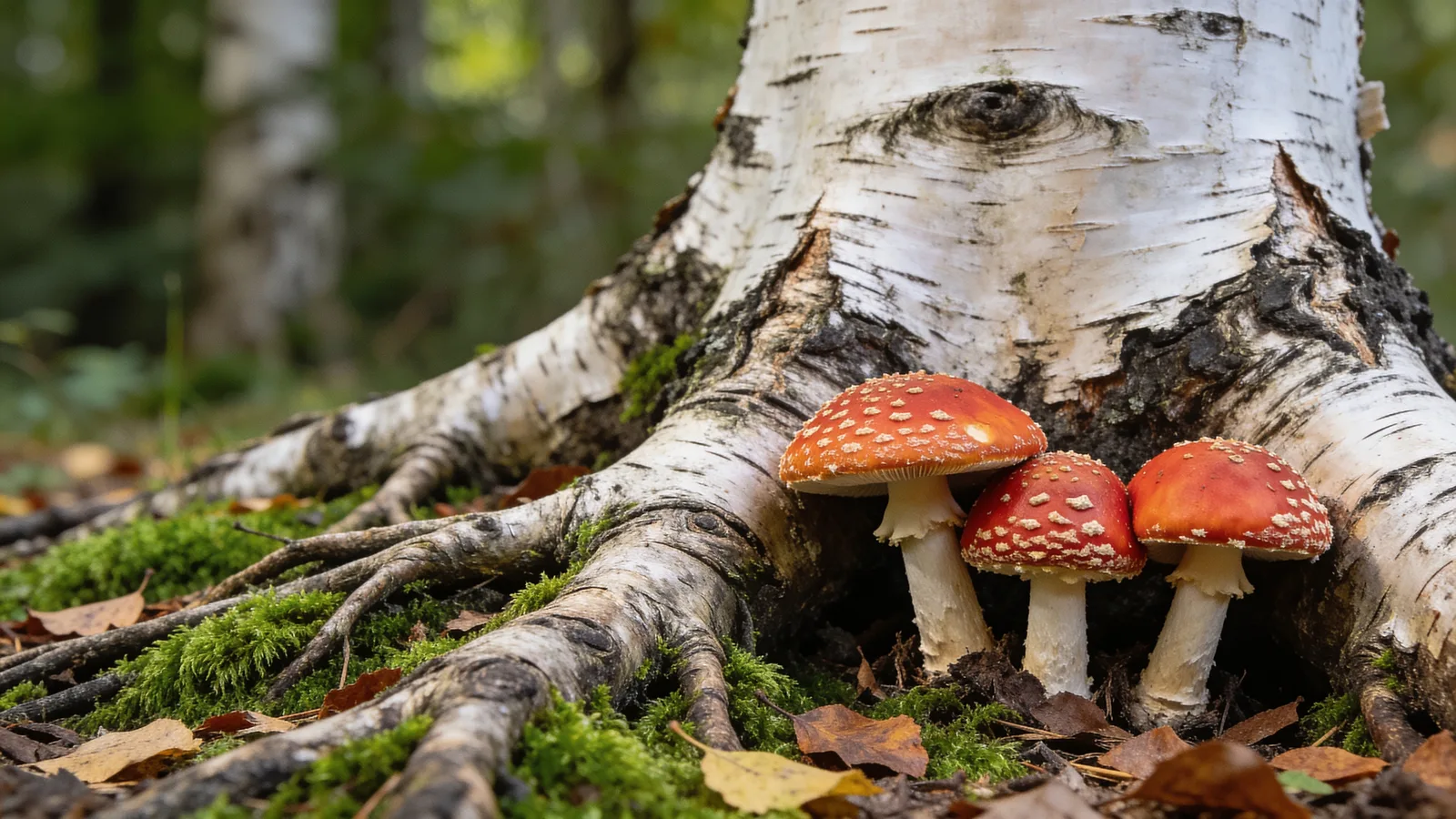
Amanita muscaria is ectomycorrhizal. Its mycelium sheathes the fine root tips of living trees: birch, pine, spruce, fir, aspen, oak. Between the root cells it forms a structure called a Hartig net. Through it the fungus hands the tree water and phosphorus and nitrogen it could not reach alone; the tree hands back sugar it made from sunlight. Neither partner is optional.
This is why you can buy cultivated oyster mushrooms by the kilo and cannot buy a cultivated fly agaric at any price. Oyster and button mushrooms are saprotrophs: give them straw, sawdust or compost and they are content. A fly agaric wants a living forest with a functioning root system, decades of it. Attempts to fruit it in cultivation have never produced anything commercially meaningful.
The consequence is worth stating plainly, because it is the one fact that governs this entire trade: every fly agaric cap in the world is wild. There is no farmed grade and no organic certification to hide behind. There is only where it was picked, when, and by whom - which is why we film the harvest and name the forest.
Colour forms and varieties
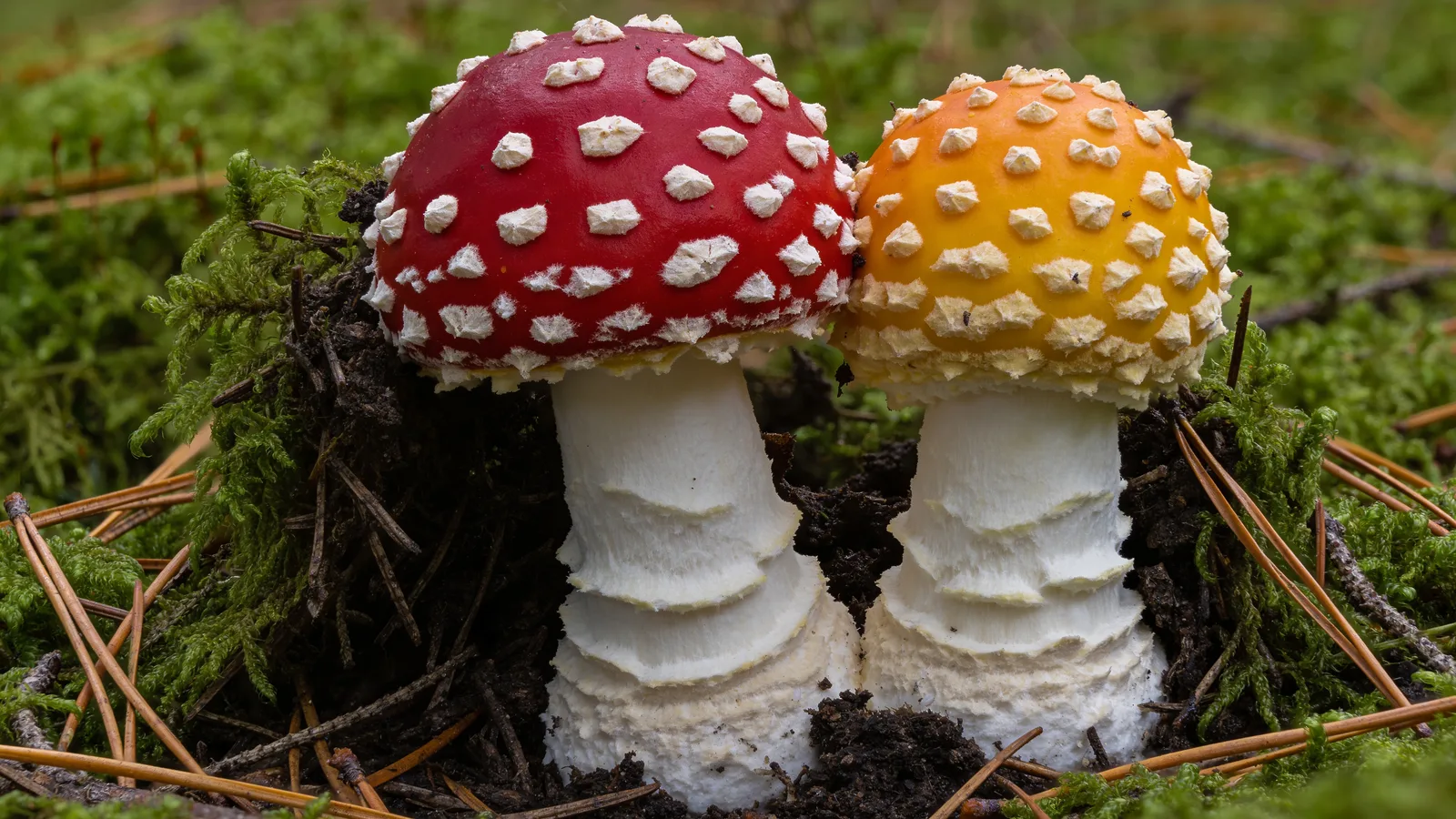
The scarlet cap of the storybook is one form among several, and the taxonomy is genuinely unsettled - DNA work over the last two decades has split, merged and re-split these repeatedly, so treat any tidy list (including this one) as provisional.
- var. muscaria - the classic: deep scarlet cap, white warts. Eurasia, and the form most people picture.
- var. flavivolvata - red to orange-red cap with yellowish warts. This is the common western North American form, and it is what grows in British Columbia.
- var. guessowii - yellow to orange cap, often with a warmer centre. Northeastern North America; some authors treat it as a separate species entirely.
- var. persicina - a peach-toned form of the southeastern United States.
- var. alba - a rare white-capped form that unsettles everyone who finds one.
Nearby sits Amanita regalis, the royal fly agaric: liver-brown cap, once treated as a variety of muscaria, now generally its own species. Then there is Amanita pantherina, the panther cap, which is a genuinely different and more dangerous proposition. See look-alikes.
Where it grows - and where it was carried
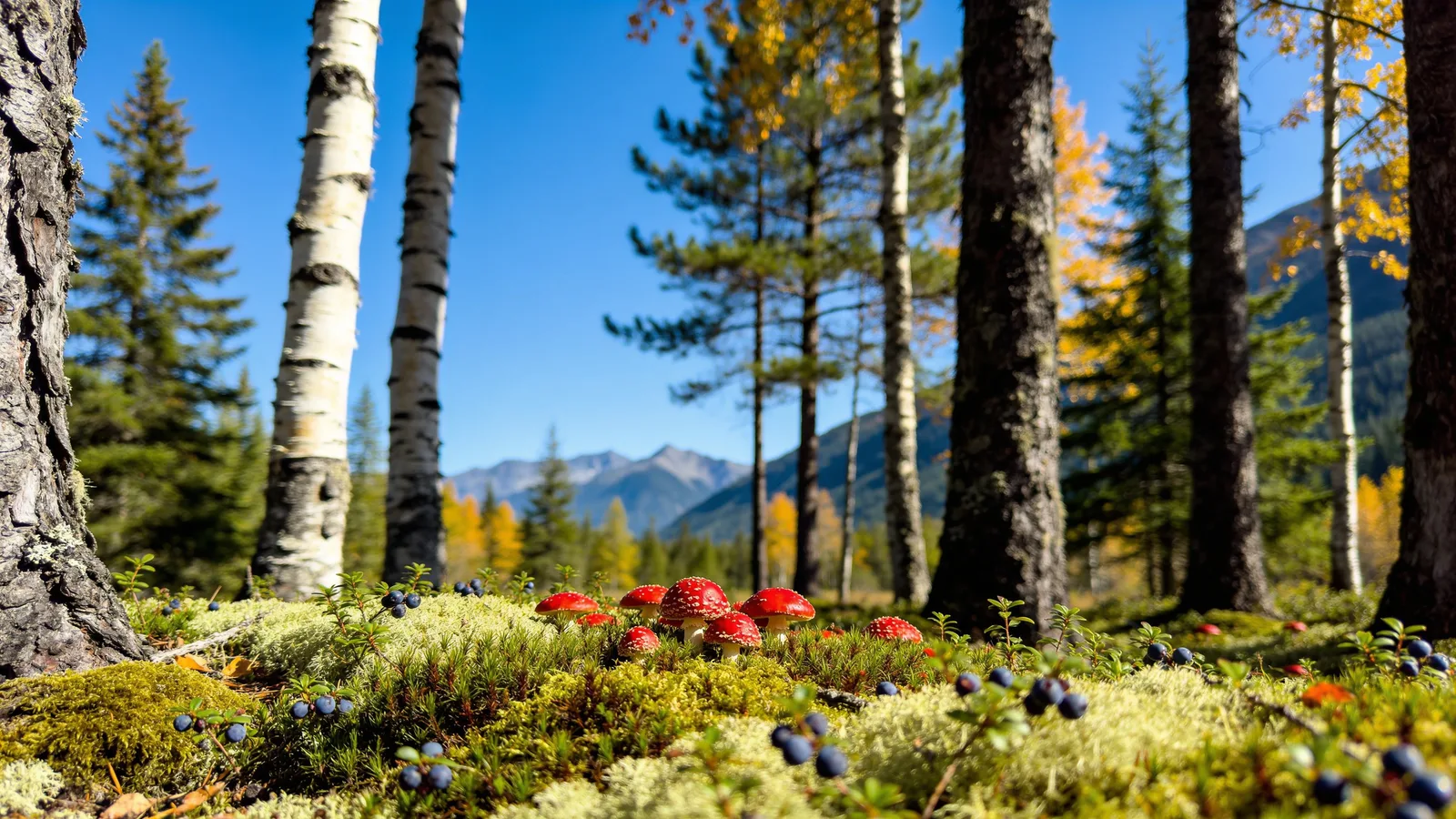
The natural range is circumpolar: across the boreal and temperate forests of Europe, Asia and North America, wherever its partner trees grow. In Canada it appears from the Atlantic provinces to the Pacific coast, fruiting in a short autumn flush that in British Columbia runs roughly from late August into early December, depending on the year and the rain.
It also travels. Twentieth-century forestry moved pine and birch seedlings around the world with fungal partners already in their root balls, and the fly agaric went with them: it is now established in New Zealand, Australia, South Africa, Chile and Argentina. In parts of New Zealand it has been documented jumping from introduced pines onto native southern beech (Nothofagus) - an invasion biologists watch with some concern, since it competes with native fungal partners.
What is inside it
Three names matter, and popular accounts get two of them wrong.
Ibotenic acid is the dominant compound in a fresh cap. It is the reason a raw fly agaric is toxic and the compound behind the poisoning reports in the literature. First isolated by Japanese researchers in the 1960s, it takes its name from ibotengutake, the Japanese name for the panther cap.
Muscimol is what ibotenic acid becomes when it loses a carboxyl group - a reaction driven by drying, gentle heat and time. It is the compound responsible for the mushroom’s characteristic activity. Every traditional preparation on record begins with drying, and this is the chemistry underneath that universal habit.
Muscarine is the famous one, and the species is barely involved. It was first isolated from Amanita muscaria in 1869 and named after it, but occurs here only in traces - the mushrooms that actually carry muscarine in quantity are Inocybe and Clitocybe species. A century and a half later, popular articles still describe fly agaric as "the muscarine mushroom". It is not.
Smaller quantities of muscazone and a shifting cast of minor compounds round out the picture, and concentrations vary enormously - by variety, by region, by season, by the individual cap, and by how it was dried. There is no such thing as a standard fly agaric.
What drying and curing change
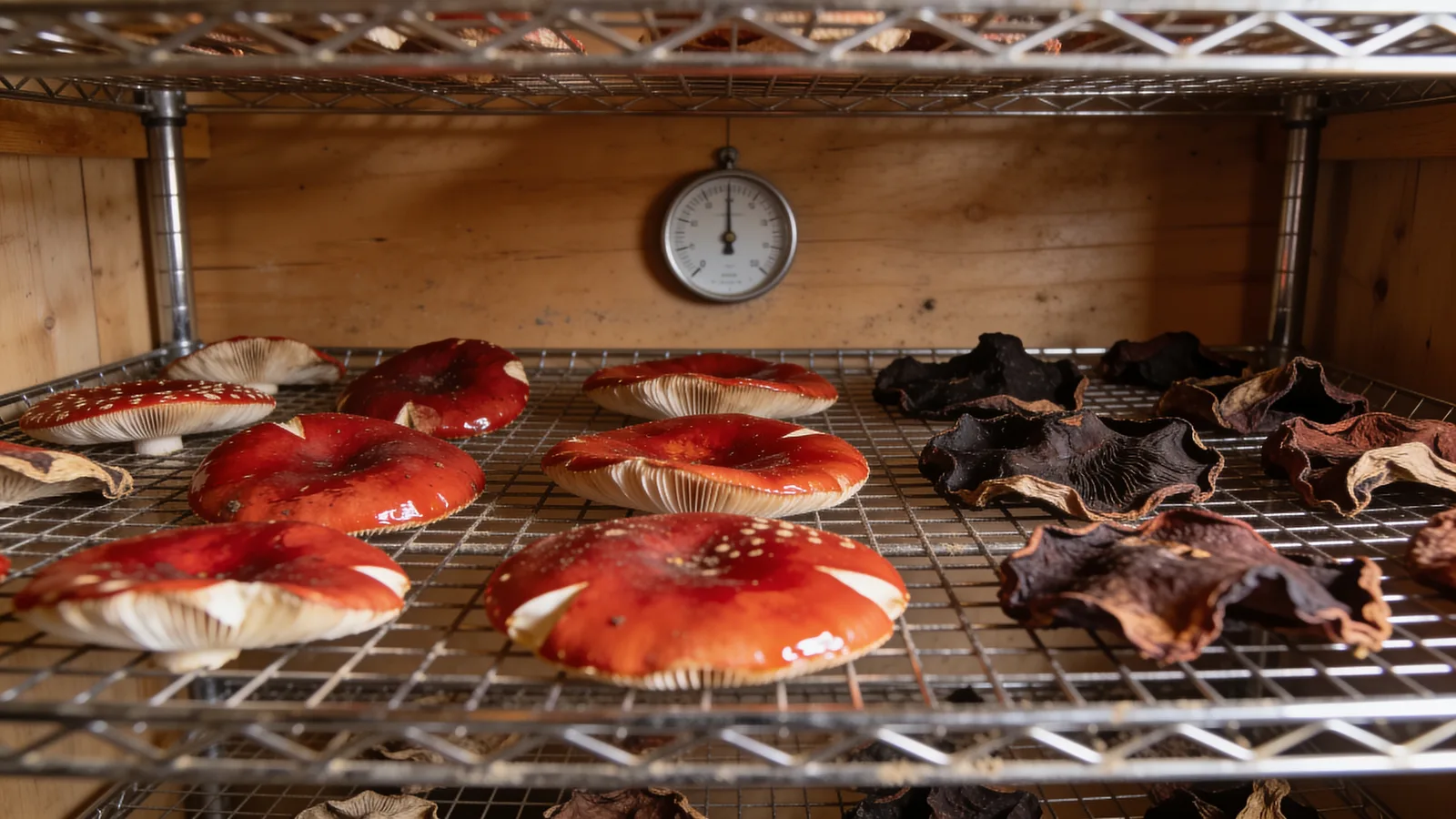
Drying is not preservation here; it is a chemical step. Warm moving air over a day and a half converts the bulk of the ibotenic acid in a cap into muscimol. A brief rise to around 90 °C at the end pushes the conversion further. Then the caps rest for months, sealed and in the dark, while the change finishes and the colour settles.
Our own method is public and unglamorous: pick at dawn, brush clean and never wash, part cap from stem, 36 hours in 40 °C moving air with a brief 90 °C finish, vacuum-seal, then three months in a cool dark room. It is described step by step on the provenance section, filmed in the 51-second harvest film, and it is the whole difference between a brick-red specimen and the scorched brown material sold elsewhere.
Two honest caveats, because this is exactly where the internet overstates things. The conversion is substantial but never complete - residual ibotenic acid remains in any cured cap. And muscimol is not an inert substance either. Documented chemistry is not a safety statement, we are not making one, and everything we ship is sold for collection and study only.
Look-alikes, and the ones that kill
 Amanita muscaria
Cap rough with warts. Base a swollen bulb with concentric bands, not a cup.
Amanita muscaria
Cap rough with warts. Base a swollen bulb with concentric bands, not a cup.
 Amanita phalloides
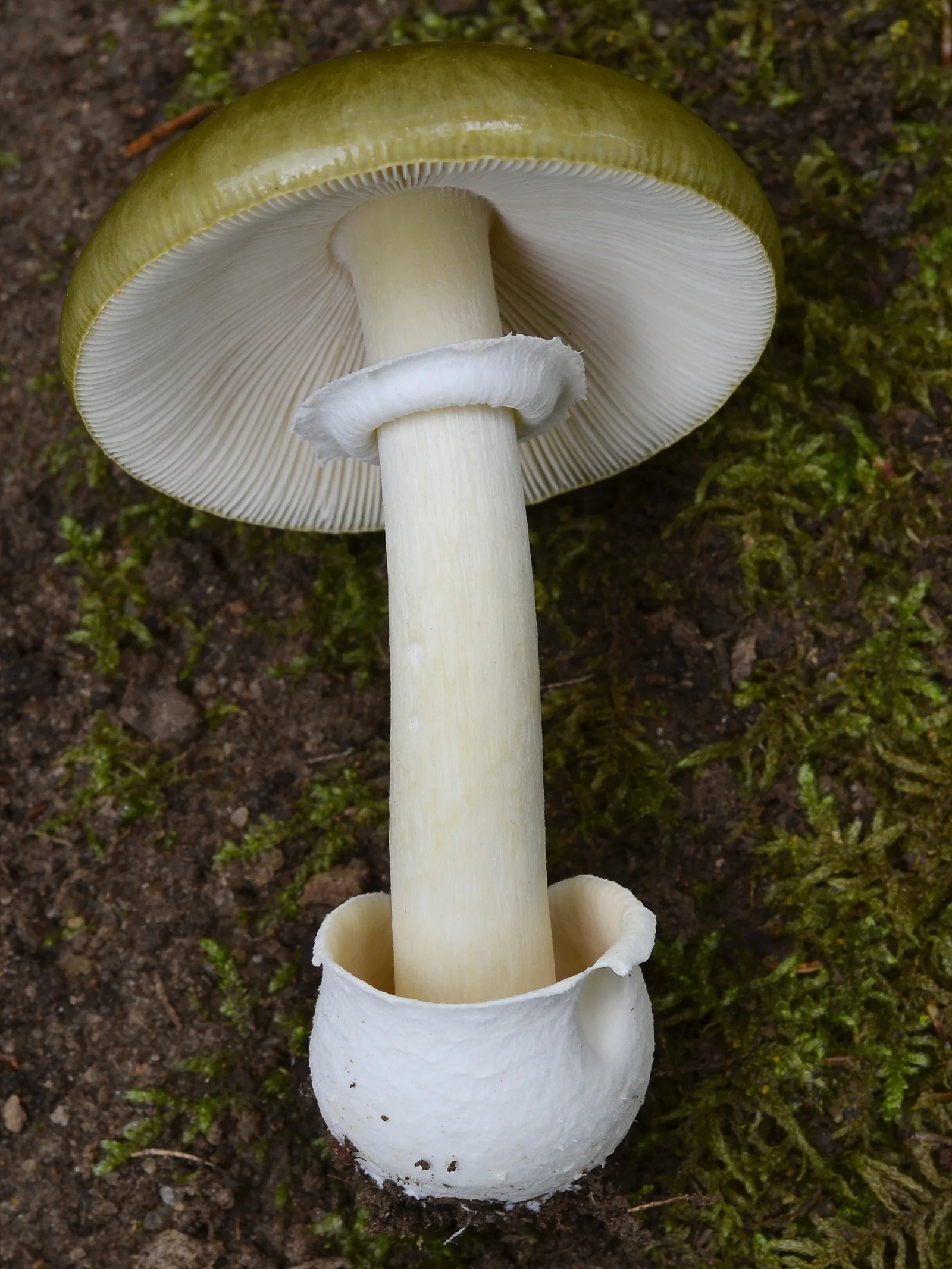
Cap smooth and olive-green. Base sits in a loose white sac, the death cup. Deadly.
Amanita phalloides
Cap smooth and olive-green. Base sits in a loose white sac, the death cup. Deadly.
A mature red-capped fly agaric is one of the few genuinely unmistakable mushrooms in the northern forest. The danger is not the mature cap. It is everything around it.
- Amanita pantherina (panther cap) - brown cap, white warts, same architecture, considerably higher ibotenic acid content. The serious poisoning cases in the literature disproportionately involve this species, frequently misidentified.
- Amanita caesarea (Caesar’s mushroom) - orange cap, yellow gills and stem, prized as an edible in southern Europe. Different mushroom, similar first impression at distance.
- The button stage - a young fly agaric still wrapped in its universal veil is a white egg. So is a young Amanita phalloides (death cap) and a young Amanita virosa / A. bisporigera (destroying angel). Those two cause liver failure and kill people every year. The death cap is established in urban British Columbia, so this is a local warning, not a European one.
The working rule of every serious forager: never identify an Amanita from the cap alone. Dig the whole base out intact, look for the volva, take a spore print, and if you are new to the genus, photograph and leave it. Our field identification guide walks through the characters one at a time.
The fly-killer: the oldest recorded use
Before it was a symbol of anything, it was a household insecticide. Albertus Magnus, writing in the thirteenth century, records the cap being broken into milk to kill flies, and the practice was still ordinary across rural Europe in the nineteenth. Sweetened water or milk on a windowsill saucer, a crumbled cap in it, and by evening the flies were stunned or dead.
This is the origin of muscaria, of Fliegenpilz, of мухомор, of tue-mouches. An entire continent named this mushroom after a kitchen chore. Whatever else the fly agaric has been to people, it was first a practical object - and that unglamorous fact is worth holding on to when reading the more dramatic material below.
Siberia and the reindeer herders
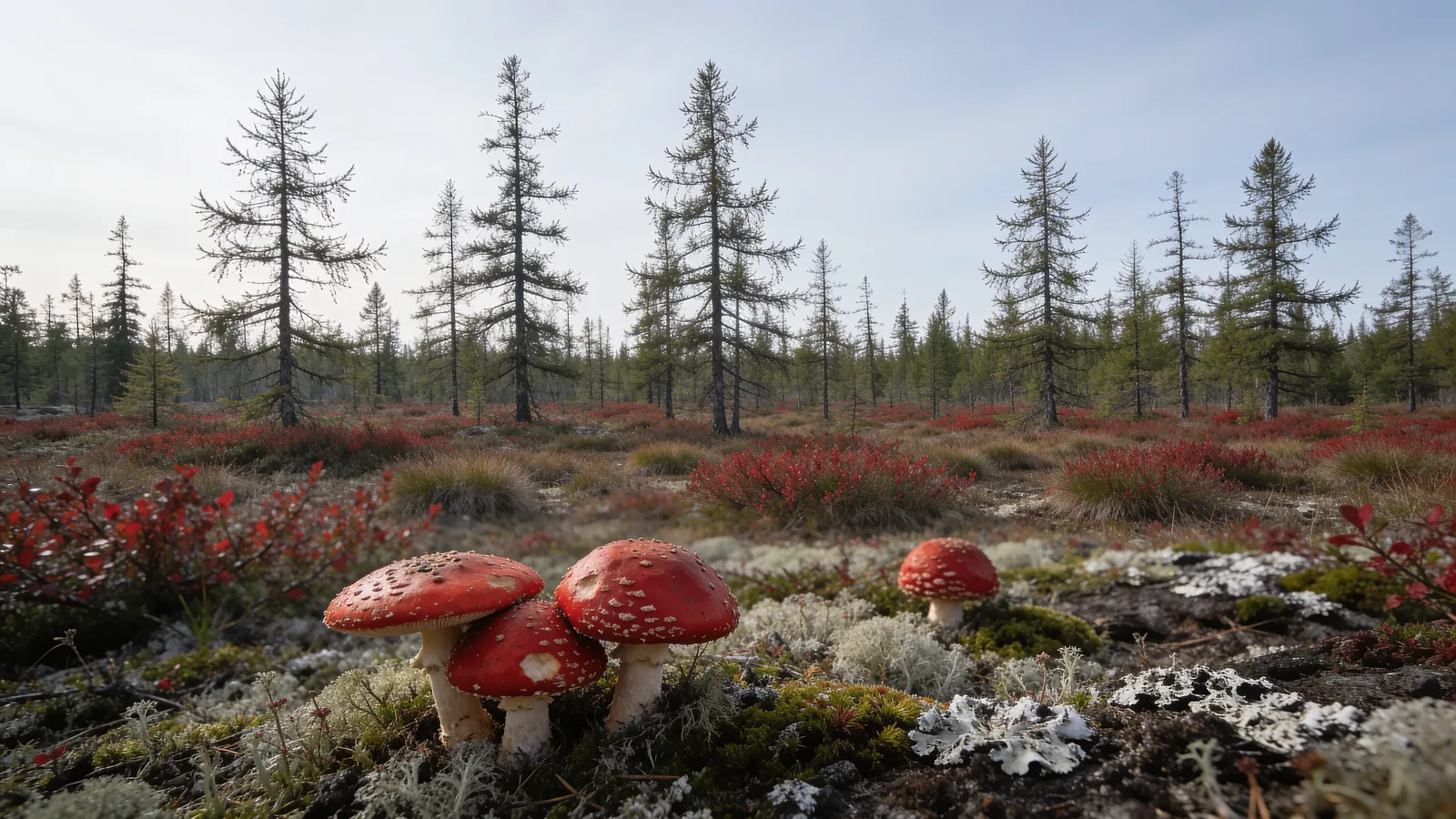
The best-documented cultural record of this mushroom comes from the Russian Far East. Among the Koryak, Chukchi, Itelmen and neighbouring peoples of Kamchatka and Chukotka, the dried fly agaric, which the Koryak call wapaq, held a defined ritual and social place. Outside observers noticed early. Filip Johan von Strahlenberg, a Swedish officer held prisoner in Siberia, published an account in 1730. Georg Wilhelm Steller and other naturalists of the Russian expeditions added more.
The systematic ethnography came with the Jesup North Pacific Expedition (1897–1902), where Vladimir Jochelson worked among the Koryak and Waldemar Bogoras among the Chukchi. Their monographs remain the primary sources - they recorded the mythology, the social rules around who used it and when, and the Koryak story of Big Raven, to whom the mushroom was given as a strength that grows from the earth where his spittle fell. We tell that story properly in Reindeer and Drum.
The reindeer connection is real and documented: reindeer seek the mushroom out, and herders observed the behaviour and drew their own conclusions from it. This is the historical bedrock on which a great deal of later, shakier theory has been built.
The Sámi and the northern winter
The Sámi of northern Scandinavia are constantly invoked in popular writing about the fly agaric - usually in the same breath as reindeer, midwinter and Santa Claus. Here honesty requires a step back: the documentary evidence for Sámi use of this mushroom is far thinner than for the Siberian peoples, and much of what circulates online is either projection from Kamchatka onto Lapland or a nineteenth-century traveller’s assumption repeated until it hardened.
What is solid is the broader northern context: a circumpolar band of cultures living with the same forests, the same reindeer and the same conspicuous red mushroom, with the drum, the smoke-hole and the midwinter dark as shared furniture. That is enough for a rich story without inventing sources.
Berserkers: the theory that will not die
In 1784 the Swedish theologian Samuel Ödman proposed that the Norse berserkir, the warriors of the sagas who fought in a howling, shieldless fury, achieved that state with fly agaric. He had never seen it done; he reasoned by analogy from published Siberian accounts. Fredrik Christian Schübeler repeated it in 1886 and the idea entered popular culture, where it has stayed for two hundred and forty years.
Modern scholarship is largely unconvinced. No saga mentions a mushroom. The behaviour described in the sources is at least as consistent with ritual psychology, group dynamics, alcohol, or straightforward literary convention. Other candidate plants, henbane in particular, have been proposed with equal confidence and equally little evidence. It is a hypothesis about a gap in the record, not a finding. We give it the full treatment in Odin’s Wager.
Soma: Wasson’s wager
In 1968 the banker-turned-ethnomycologist R. Gordon Wasson published Soma: Divine Mushroom of Immortality, arguing that the mysterious ritual drink of the Rigveda was pressed from Amanita muscaria. Soma is praised in over a hundred hymns and has never been identified botanically. It was an enormous, erudite, gorgeously produced piece of work, and it made the fly agaric famous among people who had never picked a mushroom.
It also drew immediate fire. The Sanskritist John Brough published a detailed rebuttal in 1971, arguing that the Vedic descriptions did not fit the mushroom and that Wasson had leaned on selective reading. Later scholars have proposed Ephedra, Syrian rue, and combinations of both. More than fifty years on, soma remains unidentified. Wasson’s thesis is a serious contribution to an open question - not a settled answer, whatever the internet says.
Frescoes, manuscripts and a long argument
In the chapel of Plaincourault in central France there is a fresco, dated 1291, of Adam and Eve beside a tree with a branching, red, white-flecked canopy. Wasson pointed at it and saw a fly agaric. The art historian Erwin Panofsky and colleagues pointed at a hundred other medieval paintings and saw a completely conventional stylised Italian pine - a stock motif of the period rendered by a provincial painter. The art-historical consensus is firmly with Panofsky.
The wider claim came from John Marco Allegro, whose The Sacred Mushroom and the Cross (1970) argued that Christianity itself began as a mushroom cult encoded in Semitic wordplay. It was repudiated by his own academic colleagues on publication and is not accepted by any mainstream scholar of religion or philology. We cover the whole argument, respectfully and with the criticism attached, in The Red Cap in Church and Parlour.
What survives all this is smaller and more interesting: a recurring red-capped, white-spotted visual motif in European religious art and folk embroidery. Whether it means anything is exactly the question, and honest answers are thinner than confident ones.
Santa Claus and the red-and-white question
The theory is irresistible: red-and-white, reindeer, entry through the smoke hole, a midwinter gift, a mushroom drying on a fir branch like an ornament. Told well, it feels like a key turning.
The evidence does not support it. The modern Santa assembles visibly from Saint Nicholas of Myra, the Dutch Sinterklaas, Clement Clarke Moore’s 1823 poem, Thomas Nast’s illustrations from the 1860s and commercial art of the twentieth century - a documented chain in which no mushroom appears. The Siberian material is real, but nothing connects it to the Anglo-Dutch figure that became Santa. Folklorists who have examined the claim reject it.
We weighed the whole thing, argument and counter-argument, in Was Santa a Mushroom? - and concluded that the honest answer is "almost certainly not, and it is still a wonderful story."
Мухомор: the Slavic forest
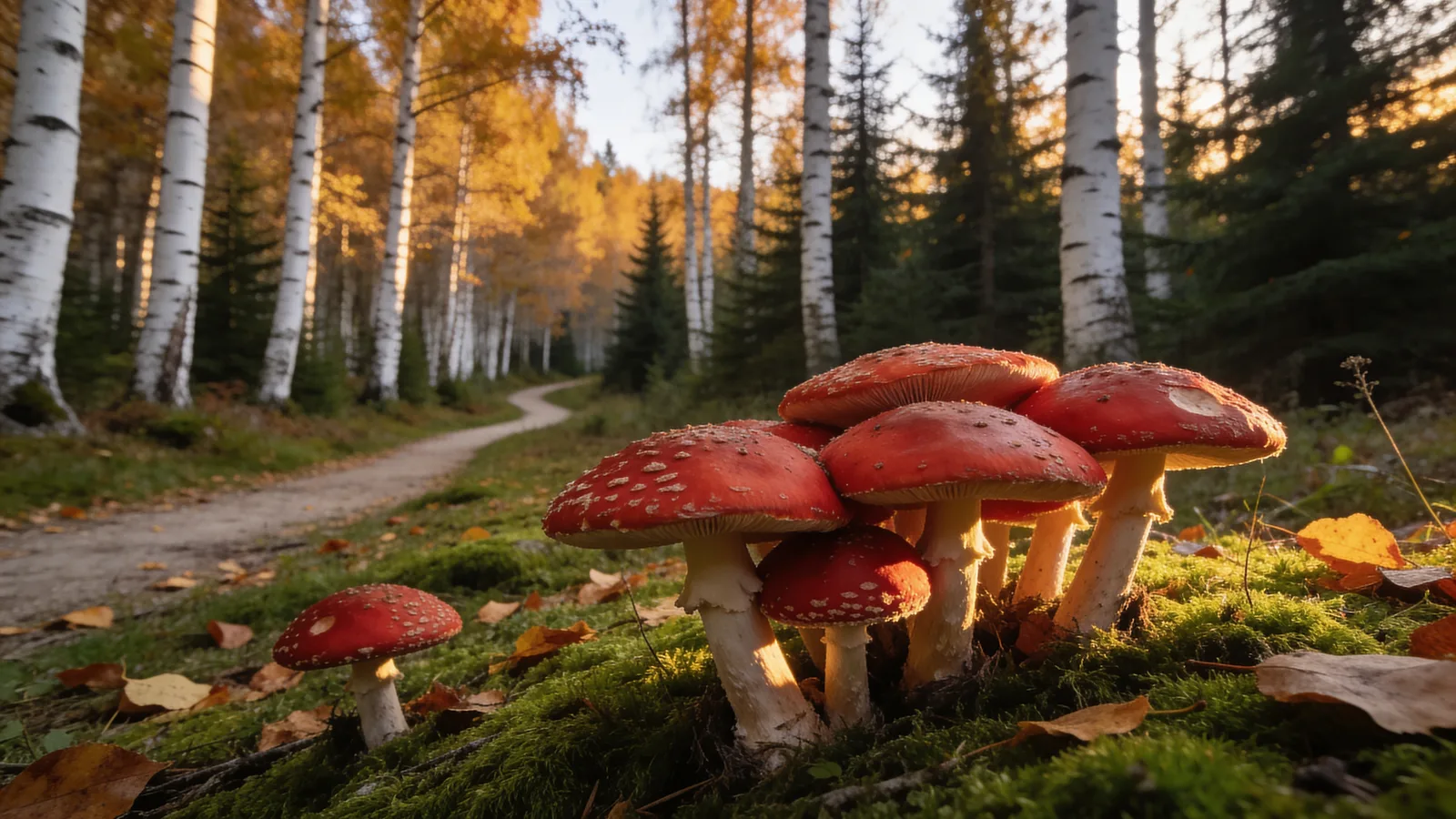
In the Slavic world the fly agaric never left everyday life. Its name is a compound of use and threat: мухомор means fly-death. It is the one mushroom every child learns first, precisely so they never pick it. Admire it, photograph it, leave it standing. Mushroom picking itself, тихая охота ("the quiet hunt"), remains one of the great seasonal rituals of Eastern Europe.
From there it moved into the visual language: Baba Yaga’s forest, lacquer miniatures, folk embroidery, Soviet children’s book illustration, the painted trays of Zhostovo. A specimen culture centuries before anyone used that phrase. Baba’s Forest follows the thread.
Victorian England, Alice and the garden gnome
Victorian Britain built an entire aesthetic on this mushroom without ever quite saying why. Fairy painting put red caps under every toadstool; Christmas and New Year cards paired them with horseshoes and chimney sweeps as tokens of luck; German Gartenzwerge, garden gnomes, arrived complete with a scarlet mushroom at their feet and never left the English lawn.
And in 1865 Lewis Carroll sat a hookah-smoking caterpillar on a mushroom whose two sides made Alice grow and shrink. Carroll never names the species; John Tenniel’s illustration is deliberately vague. The identification with fly agaric is a twentieth-century reading projected backwards - popular, plausible, undocumented.
Mario, Smurfs and the emoji
The single most widely reproduced mushroom image on earth is a red cap with white spots, and most people who see it daily have no idea it is a real species. The Super Mushroom of Super Mario Bros. (1985) makes the player grow - a straight lift of the Alice motif into a Japanese platform game. The Smurfs live inside hollowed fly agarics. The mushroom emoji 🍄, encoded in Unicode as a generic "mushroom", is rendered by nearly every vendor as an unmistakable fly agaric.
The result is a strange kind of invisibility: a species everyone can draw from memory and almost nobody can name. From Mario to the Mushroom Emoji traces how that happened.
The esoteric revival
Since the mid-twentieth century the fly agaric has acquired a second life in Western esoteric and neo-shamanic writing. Mircea Eliade’s Shamanism: Archaic Techniques of Ecstasy (1951) supplied the vocabulary: the axis mundi, the world tree, the ascent and descent. Later authors mapped the mushroom onto it, casting the birch and its scarlet companion as a literal world-tree pairing. In the Slavic-speaking world a parallel revival has grown up around the мухомор, complete with its own publishing, its own teachers and its own vigorous internal disagreements.
Two things are worth saying about all of it. First, Eliade’s framework is itself heavily criticised by modern anthropologists as a romantic universalisation of very different local practices - "shamanism" as a single worldwide phenomenon is a scholarly construct more than a finding. Second, contemporary esoteric practice is contemporary: it draws on the ethnographic record but is not continuous with it, and presenting it as an unbroken ancient tradition is a claim the sources do not support.
We record this because it is a real and substantial part of the mushroom’s cultural life, and pretending otherwise would be dishonest. Recording it is not endorsing it, and nothing on this page is instruction of any kind.
What we are not allowed to tell you
People ask what it does. There is a great deal written about this mushroom, and we are not the ones who get to summarise it for you.
Health Canada does not permit a business selling a botanical specimen to make health, wellness or therapeutic claims. So we make none, in either direction. And the literature would not let us make a simple claim even if we were allowed: the same reviews that discuss possible applications also record poisonings, hospital admissions and a firm warning against self-medication. Anyone who hands you a tidy answer about this mushroom is selling you something. Usually the mushroom.
What is not in dispute is the history. Amanita muscaria has been treated as an out-of-the-ordinary mushroom for thousands of years, set apart from every other mushroom by the reindeer herders of Siberia, by Sámi, Norse and Slavic tradition, and written about continuously ever since. That record is public. Read it yourself: the ethnography, then the chemistry, then the arguments, then the rebuttals, and read the criticism beside every claim.
Our part stops at the forest floor: gather it properly, dry it properly, cure it properly, and tell you exactly what we did.
How to pick one and leave the colony standing
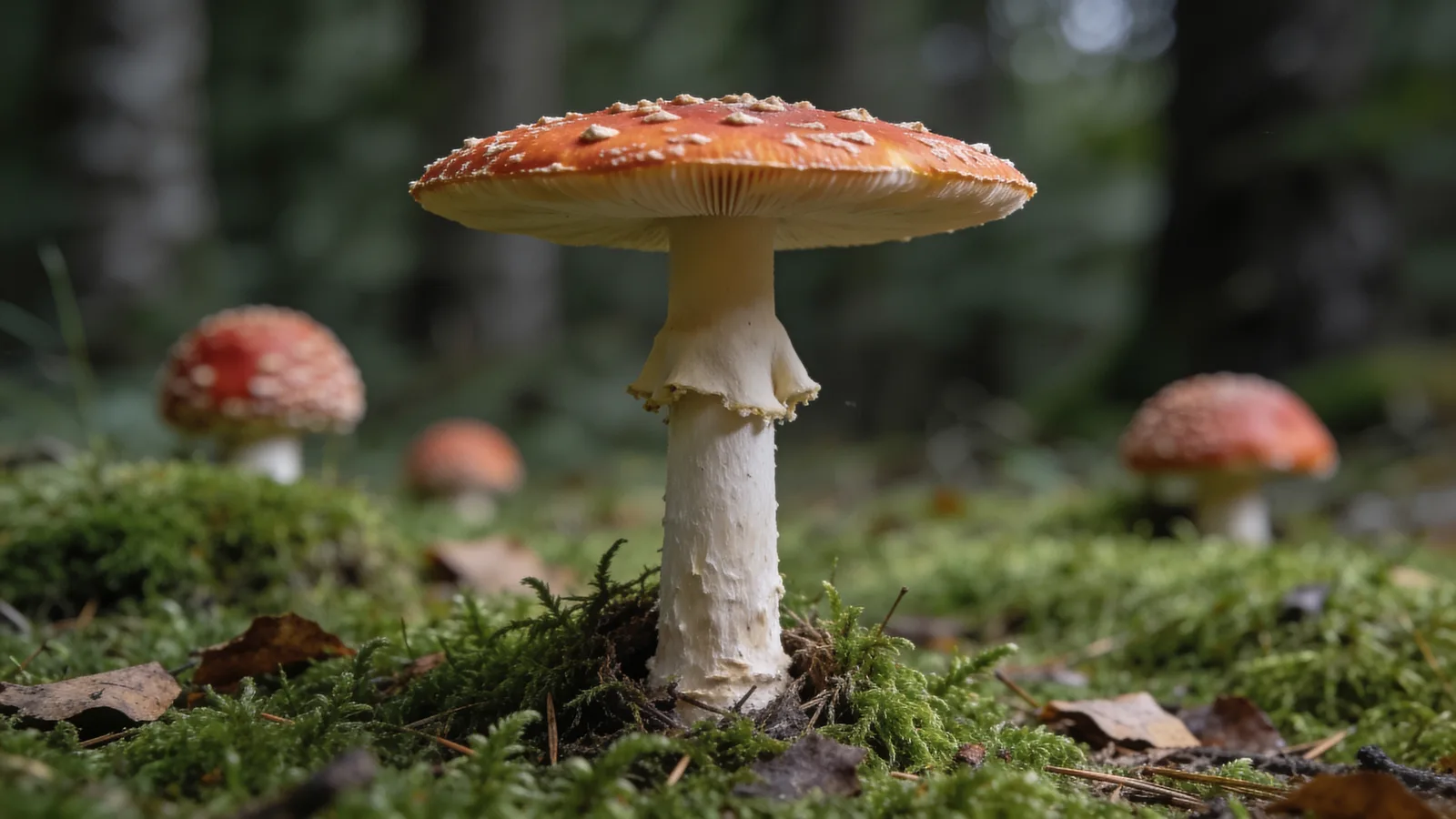
The mushroom you see is a fruiting body - the apple, not the tree. The organism itself is a mycelial network in the soil that may be decades old and may cover a hectare. Taking a cap does not kill it any more than picking an apple kills the orchard.
What does harm is everything around the picking: raking the litter layer, compacting the soil, stripping a patch bare, or damaging the partner trees. Our rules, unchanged in ten years and on two continents: take one cap and leave the group, never clear a colony, never rake, step lightly, and leave the oldest and the youngest alone. The long-running argument between foragers, cut or twist, matters far less than not trashing the ground.
Drying, curing and keeping a specimen
A dried cap is a stable object if you treat it like one. The four enemies are humidity, light, heat and air. Humidity brings mould and is the only one that will ruin a specimen outright. Light bleaches the scarlet to a sad orange within months. Heat continues chemical changes you have already finished. Air slowly dulls everything.
A vacuum-sealed pouch in a dark cupboard handles all four, which is how ours ship and how they should stay. Our full guide, including what a properly dried cap should look, feel and sound like, is How to Store Dried Amanita Muscaria.
The Canadian picture
Amanita muscaria is not a controlled substance under Canada’s Controlled Drugs and Substances Act, and neither ibotenic acid nor muscimol appears on its schedules. That is a narrow statement about drug scheduling and nothing more: the moment anything is sold for human consumption, food and natural-health-product regulation applies, which is exactly why everything on this site is sold as a botanical specimen for collection and study and never as food, supplement or medicine. Other countries take a different line, and several restrict or prohibit it outright, so this is a Canadian statement about a Canadian shop.
Practically: we pick in British Columbia, dry and cure in small batches, ship tracked to every province and territory, and take payment by Interac e-Transfer. Buyers must be 19 or older. The full terms are on the legal page, and what we actually sell is two things, whole dried caps and stone-milled powder, at any weight from 20 to 500 grams.
Questions people actually ask
What is Amanita muscaria?
Amanita muscaria, the fly agaric, is a red-capped white-spotted mushroom of the family Amanitaceae, first described by Linnaeus in 1753 and moved to the genus Amanita by Lamarck in 1783. It grows in partnership with the roots of birch, pine, spruce and other trees across the northern hemisphere, and has been introduced to the southern hemisphere with forestry plantations. It is the single most recognisable mushroom on earth - the one in every fairy tale illustration.
Why can Amanita muscaria not be cultivated?
Because it is ectomycorrhizal: the fungus lives in a physical partnership with the fine roots of living trees, trading water and minerals for sugars. No tree, no mushroom. Growers can raise saprotrophic species like oyster or button mushrooms on straw or compost, but a fly agaric needs a mature living forest. Every fly agaric cap in the world is wild by definition.
Is fly agaric the same as the poisonous mushroom in fairy tales?
Yes - and no accident. Fresh Amanita muscaria is toxic: a raw cap is loaded with ibotenic acid, the compound behind poisoning reports. That is exactly why it became the visual shorthand for "beautiful, but do not touch" in children’s books across Europe. It is not, however, one of the deadly Amanitas - those are the death cap (A. phalloides) and the destroying angels (A. virosa, A. bisporigera), which are plain white or greenish and kill by liver failure.
What is the difference between ibotenic acid and muscimol?
They are the two principal compounds of the species and one becomes the other. A fresh cap contains mostly ibotenic acid; drying, gentle heat and time decarboxylate it into muscimol. This is why traditional preparation everywhere begins with drying, and why a fresh cap and a cured one are not chemically the same object. The conversion is substantial but never total - residual ibotenic acid remains, which is one of several reasons we sell these strictly as specimens.
Why is it called muscaria if it barely contains muscarine?
A historical accident. Muscarine was first isolated from Amanita muscaria in 1869 and named after it, but it turned out to be present only in traces - far higher concentrations occur in Inocybe and Clitocybe species. The species name itself is older and comes from the Latin musca, "fly", after the medieval practice of using the cap to kill flies. The mushroom is named for flies twice over, and for muscarine not at all.
Did Santa Claus come from a mushroom?
It is a popular theory and it is not accepted by folklorists. The red-and-white colouring, the reindeer, the smoke-hole entry and the midwinter gift are a striking cluster, but the documented line to the modern Santa runs through Saint Nicholas, the Dutch Sinterklaas, Clement Clarke Moore’s 1823 poem and Thomas Nast’s illustrations - none of which mention a mushroom. Treat it as an appealing hypothesis with no primary evidence, not as history.
What are the benefits of Amanita muscaria?
We cannot tell you. Health Canada rules are clear: a business selling a botanical specimen may not make health, wellness or therapeutic claims, so we make none anywhere on this site and never will. What is not in dispute is that this mushroom has been treated as an out-of-the-ordinary one for thousands of years - set apart from every other mushroom by the reindeer herders of Siberia, by Sámi, Norse and Slavic tradition, and written about continuously ever since. The ethnography and the modern research are public. Look them up yourself, and read them critically.
Is Amanita muscaria legal in Canada?
Amanita muscaria is not a controlled substance under Canada’s Controlled Drugs and Substances Act, and neither ibotenic acid nor muscimol is scheduled there. That is a statement about drug scheduling only. Selling anything for human consumption brings food and natural-health-product rules into play, which is precisely why everything here is sold as a botanical specimen for collection and study, and never as food. Other countries differ - several restrict or prohibit it outright.
How should a dried specimen be stored?
Airtight, dark, cool and dry. Light bleaches the red, humidity invites mould, and air slowly dulls everything. A vacuum-sealed pouch kept in a cupboard holds colour and structure for years; a jar on a sunny windowsill will fade in months.
Where does ShroomsBloom pick its caps?
In the wild birch, pine and spruce forests of British Columbia, Canada, one cap at a time during the short autumn flush, leaving the colony standing. Single origin, one dawn per batch - the harvest is filmed and the process is described step by step on this site.
Sources and further reading
Primary accounts and reference works, so you can check us rather than trust us. Read the criticism next to the claims - in this field it is where most of the value sits.
- Jochelson, V. - The Koryak (Jesup North Pacific Expedition, 1905–1908): the foundational ethnography of Kamchatka.
- Bogoras, W. - The Chukchee (1904–1909): the companion volume for Chukotka.
- Wasson, R. G. - Soma: Divine Mushroom of Immortality (1968): the thesis that started the modern argument.
- Brough, J. - “Soma and Amanita muscaria”, BSOAS (1971): the principal scholarly rebuttal.
- Ödman, S. (1784) and Schübeler, F. C. (1886): the origin of the berserker hypothesis.
- Allegro, J. M., The Sacred Mushroom and the Cross (1970), and the contemporary academic responses to it.
- Wikipedia: Amanita muscaria, a well-sourced overview with the taxonomy and chemistry references collected in one place.
- Wikipedia: Plaincourault Chapel, the fresco, and the Wasson-Panofsky disagreement.
- Wikipedia - Muscimol and Ibotenic acid: entry points into the chemical literature.
- Our own field journal - nine articles, each with its own sources.
botanical specimen · not for consumption · 19+. Fresh Amanita muscaria (fly agaric) is toxic - a raw cap is loaded with ibotenic acid, which careful drying and curing convert largely into muscimol. Nothing on this page is advice, instruction or a health claim of any kind; it is a reference to a mushroom and its literature. Everything we sell is a botanical specimen for collection and study.