The Red Cap in Church and Parlour - frescoes, icons, and Victorian England
From the Plaincourault fresco to Alice's caterpillar: eight centuries of the fly agaric hiding in plain sight - in chapels, manuscripts, icons and Christmas cards - and the fierce scholarly fight over what it means.
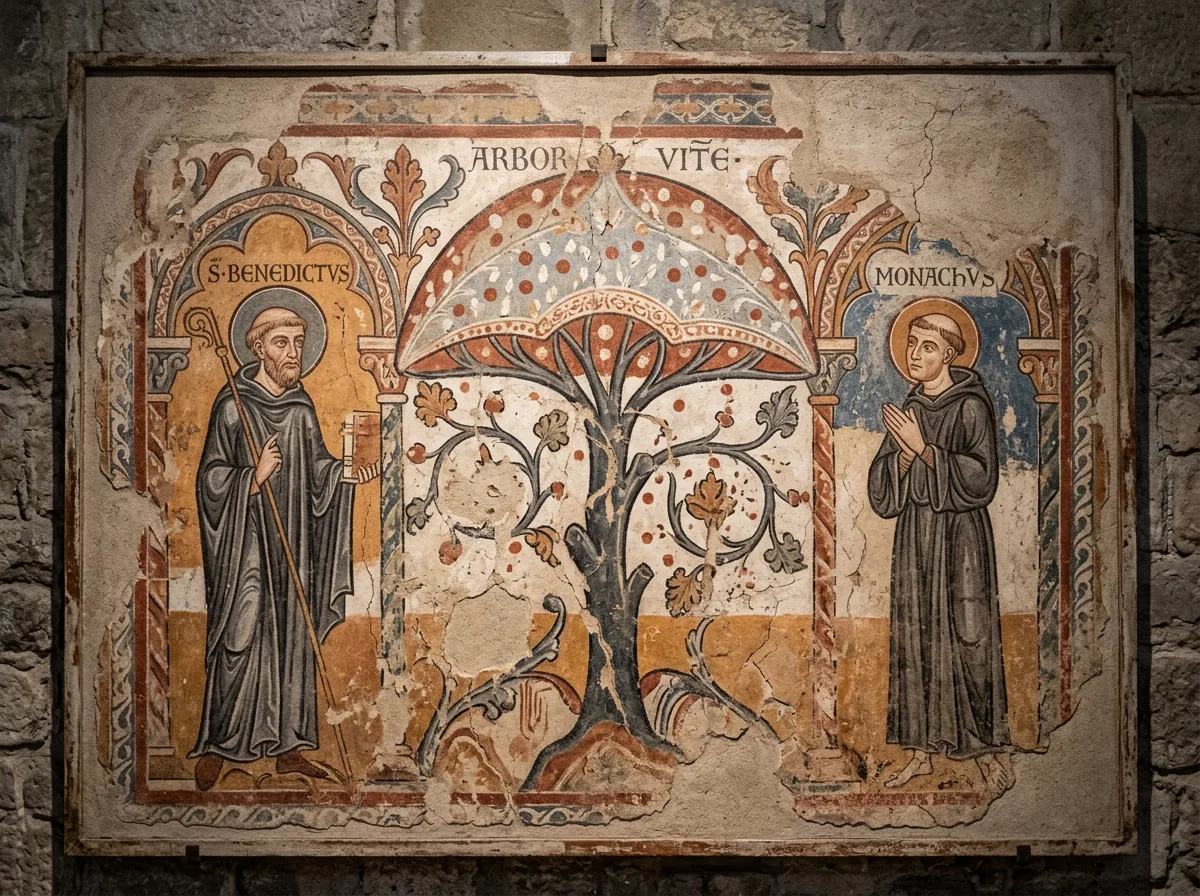
Romanesque fresco of an Arbor Vitae whose red canopy is flecked with white spots like a fly agaric cap, flanked by two robed monks
TL;DR
- A red-capped, umbrella-shaped «tree» appears in Romanesque frescoes, most famously at Plaincourault (~1291), and in later manuscripts and icons.
- One camp (Wasson’s correspondents, Allegro at the extreme, and modern minority papers) reads these as deliberate Amanita muscaria; art historians after Panofsky read them as stylized pines. The dispute is real and unresolved in the popular imagination.
- By the Victorian era the fly agaric goes fully public: Tenniel’s Alice caterpillar sits on it, fairy painters set whole scenes on it, and Christmas cards print it as a luck charm.
- Eight centuries of imagery - and the mushroom itself never changed. Ours is the wild Canadian version, dried and sealed. Botanical specimen · not for consumption · 19+.
A chapel in Indre
In a small Romanesque chapel at Plaincourault, painted around 1291, Adam and Eve stand on either side of the Tree of Knowledge - and the tree is strange. A thick stalk, a domed scarlet canopy flecked with pale spots, smaller domes branching below. To a mycologist’s eye it is unmistakable: a giant fly agaric. Photographs of the fresco have circulated in ethnobotany books for a century as Exhibit A that someone, in medieval France, painted the mushroom into Eden.
Art history answers with a cooler eye. Erwin Panofsky, among the most respected art historians of the twentieth century, replied to R. Gordon Wasson directly: the «mushroom tree» is a stylized Italianate pine, a standard convention of Romanesque and Byzantine painting, and examples without any resemblance to fungi fill the same centuries. Most specialists have agreed with him since.
The man who bet his career
The strong version of the claim arrived in 1970, when John M. Allegro, a serious Dead Sea Scrolls philologist, published The Sacred Mushroom and the Cross, arguing that early Christian language itself encoded an Amanita muscaria cult. The scholarly world did not argue back so much as close the door: the etymologies did not hold, colleagues repudiated the book, and Allegro’s academic standing never recovered. It remains the cautionary tale of this whole subject - and, inevitably, its most-read text.
The idea did not die with him. Papers still appear defending versions of it - including a recent ResearchGate study linked in our sources (submitted by a reader of this journal) that argues the mushroom served as a sacrament symbol far later than Allegro claimed. We link it as what it is: a minority position, contested by mainstream scholarship, and part of the genuine history of this argument.
Icons, manuscripts, margins
Between the fresco and the fight, the pattern keeps surfacing quietly: umbrella-capped «trees» in the Saint-Savin frescoes, dome-headed plants in psalter margins, red-capped forms in Eastern icon backgrounds and peasant embroidery that echo the Slavic folk memory of the мухомор. Each case, taken alone, dissolves under an art historian’s patience. Taken together, they explain why the question refuses to close: the shape is simply there, century after century, wherever northern forests met paint.
The parlour takes over
Victorian England ends the ambiguity by making the mushroom explicit. John Tenniel sits Alice’s caterpillar on an unmistakable toadstool in 1865. Fairy painters, Richard Doyle above all, furnish entire miniature worlds with red-and-white caps. And the new industry of printed Christmas cards adopts the fly agaric as a luck token beside holly and horseshoes, mailing millions of little red caps across the Empire every December. What the fresco may have hidden, the parlour framed and hung on the wall.
The through-line of eight centuries is not a secret cult. It is simpler: this mushroom is the most paintable organism in the northern forest, and every age found a place for it. We keep the tradition literal - the same species, wild from the Coast Mountains of British Columbia, dried and vacuum-sealed as a specimen for collection and study. Look closely; that has always been the point.
Botanical specimen · not for consumption · 19+. This article surveys art history and contested theories; it makes no religious or health claims. Fresh Amanita muscaria is toxic - a raw cap is loaded with ibotenic acid, which careful drying and curing convert largely into muscimol.
Questions, answered
What is the Plaincourault fresco?
A ~1291 fresco in a small chapel in Indre, France, showing the Tree of Knowledge as a branched, umbrella-capped form that many viewers read as a giant fly agaric. Mycophiles cite it as evidence; art historians answer that it is a stylized Italianate pine typical of the period.
Did John Allegro really claim Christianity grew from a mushroom cult?
Yes - in 'The Sacred Mushroom and the Cross' (1970) the Dead Sea Scrolls philologist argued sacred names encoded Amanita muscaria. The book was rejected almost universally by scholars and cost him his career; it remains the most famous, and most criticized, statement of the idea.
So are the 'mushroom trees' in church art really mushrooms?
The honest answer: the resemblance is real, the intent is unproven. Art historians led by Erwin Panofsky trace the form to stylized pines in Byzantine and Romanesque convention. A minority of researchers keep the question open. Both positions are linked in our sources.
Why does the fly agaric appear on Victorian Christmas cards?
In 19th-century Britain and Germany the red-and-white cap was a printed token of good luck, alongside horseshoes, clover and chimney sweeps - decorative folklore, not pharmacology.
Can I see this mushroom in person?
Yes - as a botanical specimen: wild Canadian Amanita muscaria, dried and sealed, in the ShroomsBloom collection. Not for consumption. 19+.
Sources & further reading
- Plaincourault Chapel and its fresco
- John M. Allegro - 'The Sacred Mushroom and the Cross' and its reception
- Owner-submitted study: 'Amanita muscaria: The Holy Sacrament of the Order of Melchizedek…' (ResearchGate - a contested minority view)
- R. Gordon Wasson, the Wasson,Panofsky exchange on 'mushroom trees'
- John Tenniel's Alice illustrations - the caterpillar on the mushroom
- Victorian Christmas cards (V&A collections)
Keep reading

botanical specimen · not for consumption · 19+