Odin's Wager - the Norse thread
Where the sagas keep their mushrooms, why the berserker theory refuses to die, and what the north actually remembers about red.
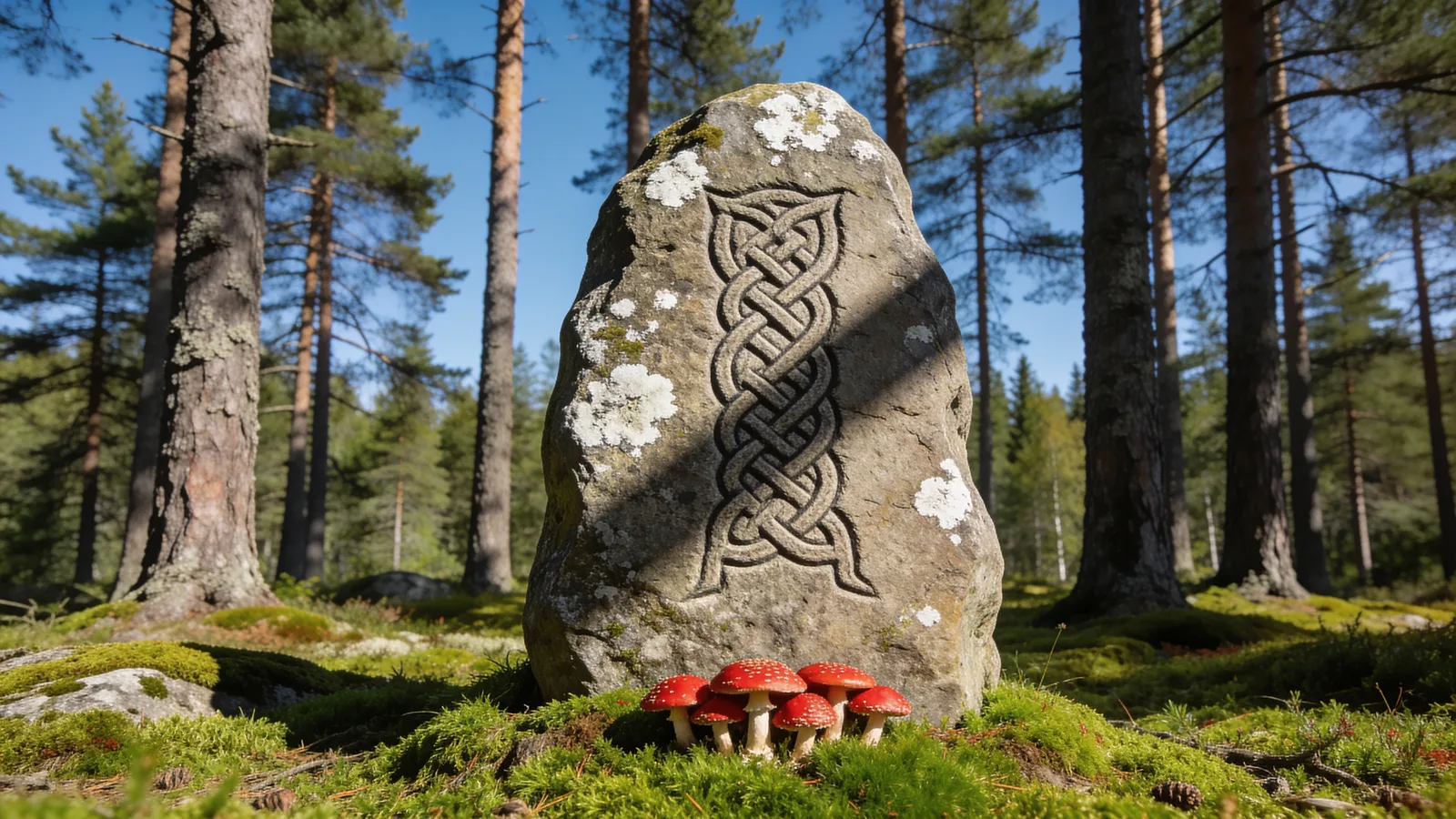
Dried fly agaric caps growing at the foot of a carved Norse rune stone in a mossy pine forest, wild Amanita muscaria of the kind ShroomsBloom dries in Canada
TL;DR
- The sagas never mention a mushroom, the berserker,fly agaric link is a 1784 hypothesis by Samuel Ödman, still argued about, never proven.
- What is certain: Amanita muscaria has fruited under Scandinavian birches and spruces since the ice left, the same species that rises under the birches of coastal British Columbia.
- The red cap survives in the north’s folk memory as a marker of luck, danger and winter - not as a recipe.
- This is our fantasy corner: legends retold as legends, with the silences left where they are.
- We keep it that way: our specimens are for collection and study, not for consumption. 19+.
The bear-shirts, as the sagas leave them
They arrive in the story already changed. That is the first strange thing about the berserkers. Nobody in the sagas watches a man become one; he is simply there at the front of the line when the shield-wall meets, without a mail-coat, without a helm, in the skin of the animal he has taken for a name. Berserkr, bear-shirt. Beside him in the older poems walk the úlfheðnar, the wolf-coats, who howl.
Snorri Sturluson, writing his history of the kings some two centuries after the last of the old religion, gives the picture its finished shape. Odin’s men went to battle “without mail-coats, mad as dogs or wolves,” biting their shields, “strong as bears or bulls,” and neither fire nor iron told upon them. In the skaldic poem about the sea-fight at Hafrsfjord the berserkers are heard before they are seen: bellowing over the water, the wolf-coats shrieking, the iron ringing on the king’s ships.
Then the story does something that legends almost never do. It stops. The sagas describe the fury from the outside and never once explain where it came from. No potion is named. No rite is described. The men shake, their teeth chatter, the colour leaves and floods back into their faces, they cannot be reasoned with, and afterwards they lie down as weak as newborns and sleep. Whatever it was, the storytellers either did not know or did not think it worth setting down, and that silence is the hole the last two hundred years of theory have been poured into.
By the eleventh century Iceland had grown tired enough of the whole business to put it in the law books. Going berserk became an offence you could be outlawed for, alongside the men who kept you company while you did it. The god’s own bodyguard had become a public nuisance. That is usually how a legend ends: not disproved, just legislated.
A hypothesis older than the lightbulb
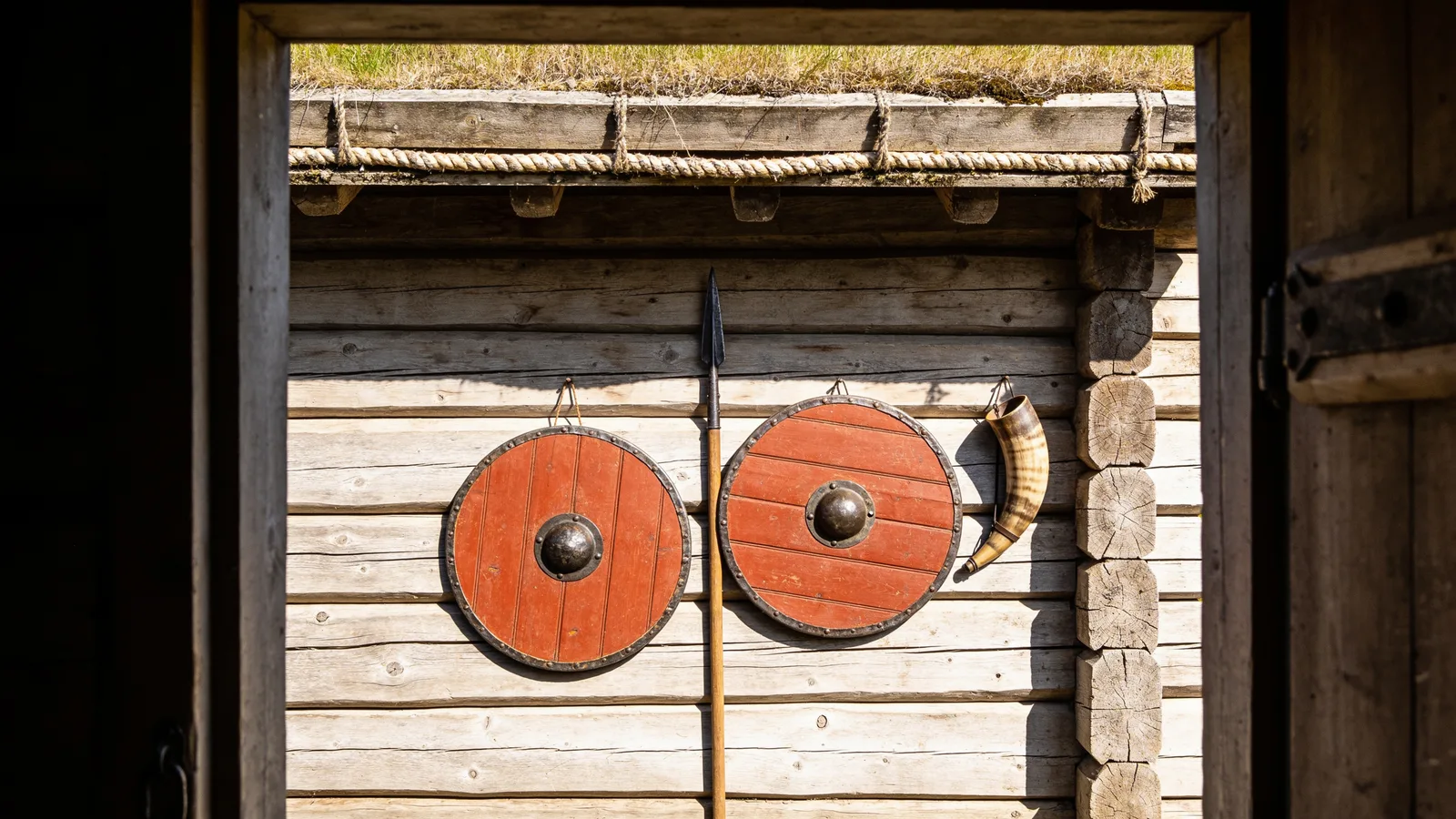
In 1784 a Swedish theologian named Samuel Ödman, who had never seen a battle and never travelled anywhere near the people he was writing about, filled the hole. He had been reading traveller’s reports out of Siberia, where the red cap turns up in the winter accounts of the reindeer herders. He put the two halves together and proposed that the bear-shirts had done the same thing, and the sentence has outlived every scholar who has tried to kill it.
It arrived with no source, no saga line, no witness. It arrived, in other words, the way most great stories do.
Two centuries of people have taken the wager since. The neurologist Howard Fabing picked it up again in 1956 and gave it a modern vocabulary. Others have pushed back hard, and the pushing back is more interesting than the theory. The saga symptoms, the shivering and the chattering teeth and the collapse, look to plenty of readers more like a trance a man works himself into than anything the forest floor could hand him. Berserksgangr ends abruptly with exhaustion, which fits fury better than chemistry. And the sagas themselves are late: Christian scribes writing down pagan ancestors three centuries after the fact had every reason to make those ancestors monstrous, and every storyteller’s reason to make them good copy.
The theory got a second wind in 1968, when R. Gordon Wasson argued that the soma of the Rigveda was this same mushroom. Suddenly the fly agaric was a candidate for the hidden engine behind an entire ancient religion, and the Norse version looked less like a guess and more like a pattern. Wasson’s case is still argued about too. Patterns are seductive that way. Two unproven things leaning against each other stand up surprisingly well.
Our position on all of it is unromantic and we are not going to pretend otherwise. There is no evidence. There is a good story, an honest gap in the record, and a mushroom that grows in exactly the wrong place to make the coincidence comfortable.
The forest under the story
Open the Eddas looking for the mushroom and you will not find it. You find a hanged god who traded nine nights on a windy tree for the runes, and an eye at Mimir’s well for one drink of memory. You find ravens who go out at dawn and come back with the world in their beaks. You find a tree that holds nine realms in its roots. No mushroom anywhere, not once.
But look at where the stories are standing. Yggdrasil is usually read as an ash. The forest the skalds actually walked through on the way to tell the story was birch, spruce and pine, and those are precisely the trees that Amanita muscaria (fly agaric, мухомор красный) partners with, its mycelium braided into their roots in an exchange older than any god we have a name for. The mushroom cannot live without them and, on poor northern ground, they do noticeably better with it.
The fly agaric is not in the mythology. It is under it. The same red comes up under the same birches on the Canadian side of that forest every August, and the caps we dry from it are the ones in our collection of dried Amanita muscaria specimens.
Odin’s whole method, in every story anyone bothered to keep, was the wager: give up the eye, hang on the tree, spend something irreplaceable and take knowledge back. It is a very old way of saying that the good things are kept behind a price. The berserker theory is popular because it fits that shape too neatly. Somebody paid something, and got the fury.
Why the north remembers red
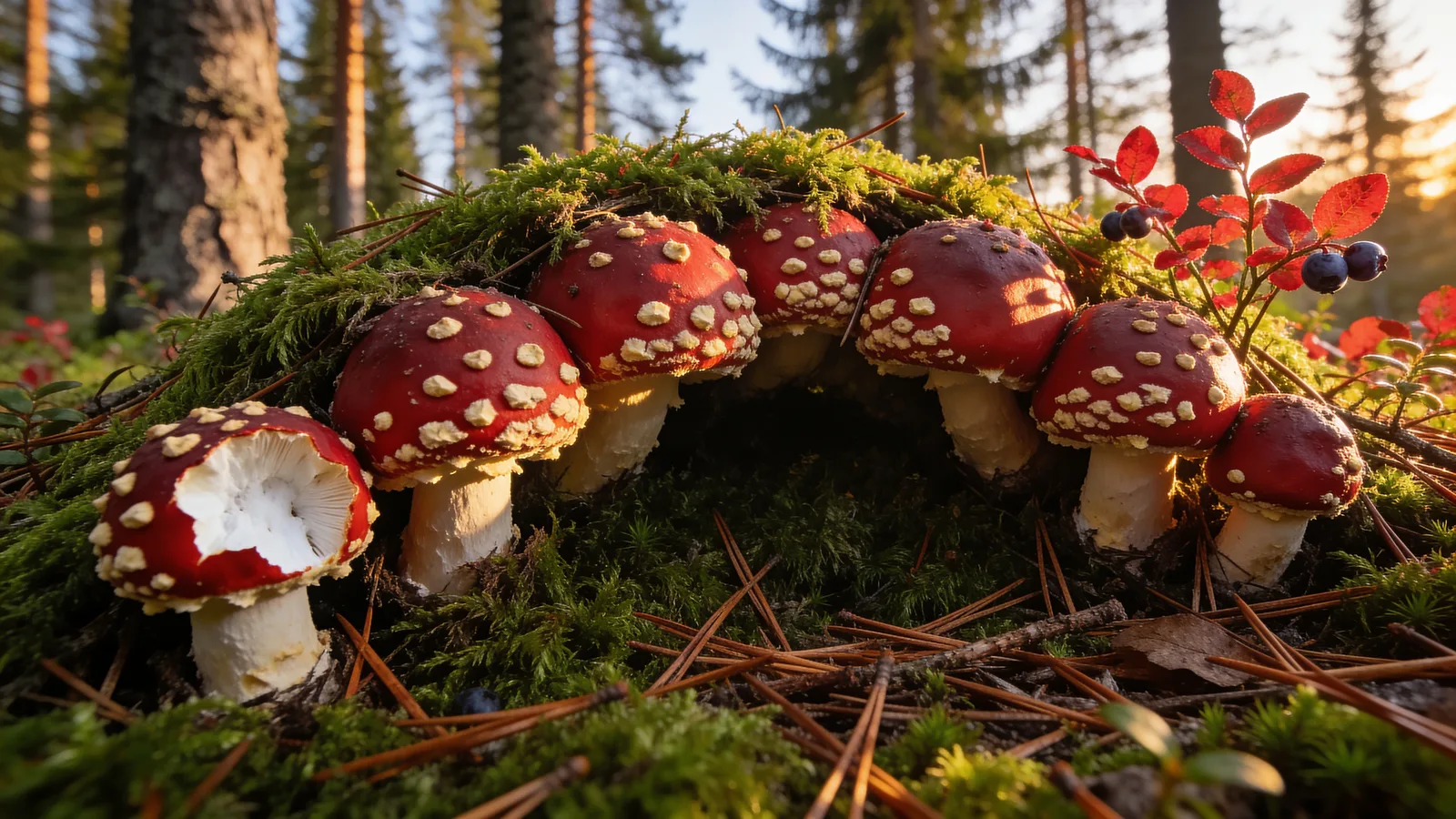
Long after the sagas were written down and the law books had done their work, the red cap kept its job in the north. It just changed shifts.
On nineteenth-century Christmas and New Year cards it turns up as a plain token of luck, painted next to horseshoes, chimney sweeps and pigs, and German still calls a lucky person a Glückspilz, a lucky mushroom. In children’s books it stands at the margin of the picture, slightly too bright, always at the edge of the dark trees, doing the work of a road sign. Farmers noted its fruiting the way you note a date: when the red caps come up, the year has turned toward winter, so get the wood in.
Festive and forbidding in the same breath. That double reputation is the honest one, and the north earned it by never quite domesticating the thing. It admired the fly agaric from a respectful distance, the way you admire weather. Nobody put it in the pot. Everybody painted it.
Our own version of that distance is a vacuum-sealed pouch of wild-picked British Columbia caps: the whole story kept, the wager declined.
The thread that leads here
Follow the mushroom rather than the forest and it does not stop at Scandinavia. Amanita muscaria is circumpolar: Iceland’s plantations, the whole width of Siberia, and then the Pacific side of North America, where it comes up under the birch and Douglas-fir of the Coast Mountains of British Columbia and our own batches are gathered one dawn at a time. A different forest, a wetter one, several thousand kilometres off. Same partnership underground, same red answering the same first cold nights.
The finished caps out of those Canadian batches keep the muted brick-red the sagas’ forests knew, sealed for a shelf instead of a story. Odin’s wager stays unsettled, and will, because the only witnesses stopped writing eight hundred years ago and left the interesting part out. The forest, quietly, keeps paying out anyway.
Botanical specimen · not for consumption · 19+. Folklore is not guidance and nothing in this article is advice; fresh Amanita muscaria is toxic - a raw cap is loaded with ibotenic acid, which careful drying and curing convert largely into muscimol.
Questions, answered
Did Viking berserkers really eat fly agaric?
There is no direct evidence. The idea was proposed in 1784 by Samuel Ödman and has been debated ever since; most modern scholars treat it as an attractive but unproven hypothesis. The sagas themselves never name a mushroom.
Does Amanita muscaria actually grow in Scandinavia?
Yes - abundantly. It fruits in late summer and autumn in birch, spruce and pine forests across Norway, Sweden and Finland, the same mycorrhizal partnerships it keeps in the Coast Mountains of British Columbia.
Is the fly agaric in Norse mythology itself?
Not by name. The Eddas mention sacred trees, mead and ravens, never mushrooms. The connection lives in later folklore and in the landscape: the fly agaric grows at the feet of the very birches and spruces the myths are set among.
Is this article history or storytelling?
Storytelling. This is our myths and legends corner. We retell what people are said to have believed, we name the point where the sagas go silent, and we give no instructions of any kind.
Can I consume Amanita muscaria the way the theory says berserkers did?
No. Fresh Amanita muscaria is toxic: a raw cap is loaded with ibotenic acid, which careful drying and curing convert largely into muscimol. Everything ShroomsBloom offers is a botanical specimen for collection and study - not for consumption. 19+.
Sources & further reading
- Berserker - the Ödman hypothesis and its critics (overview)
- R. Gordon Wasson, 'Soma: Divine Mushroom of Immortality' (1968)
- Amanita muscaria - distribution and ecology
- Е. П. Батьянова, М. М. Бронштейн. Мухомор в быту, верованиях, обрядах, искусстве народов Севера, 2016 - the Siberian reports Ödman was reading from
- Howard D. Fabing, 'On Going Berserk: A Neurochemical Inquiry' (1956)
Keep reading
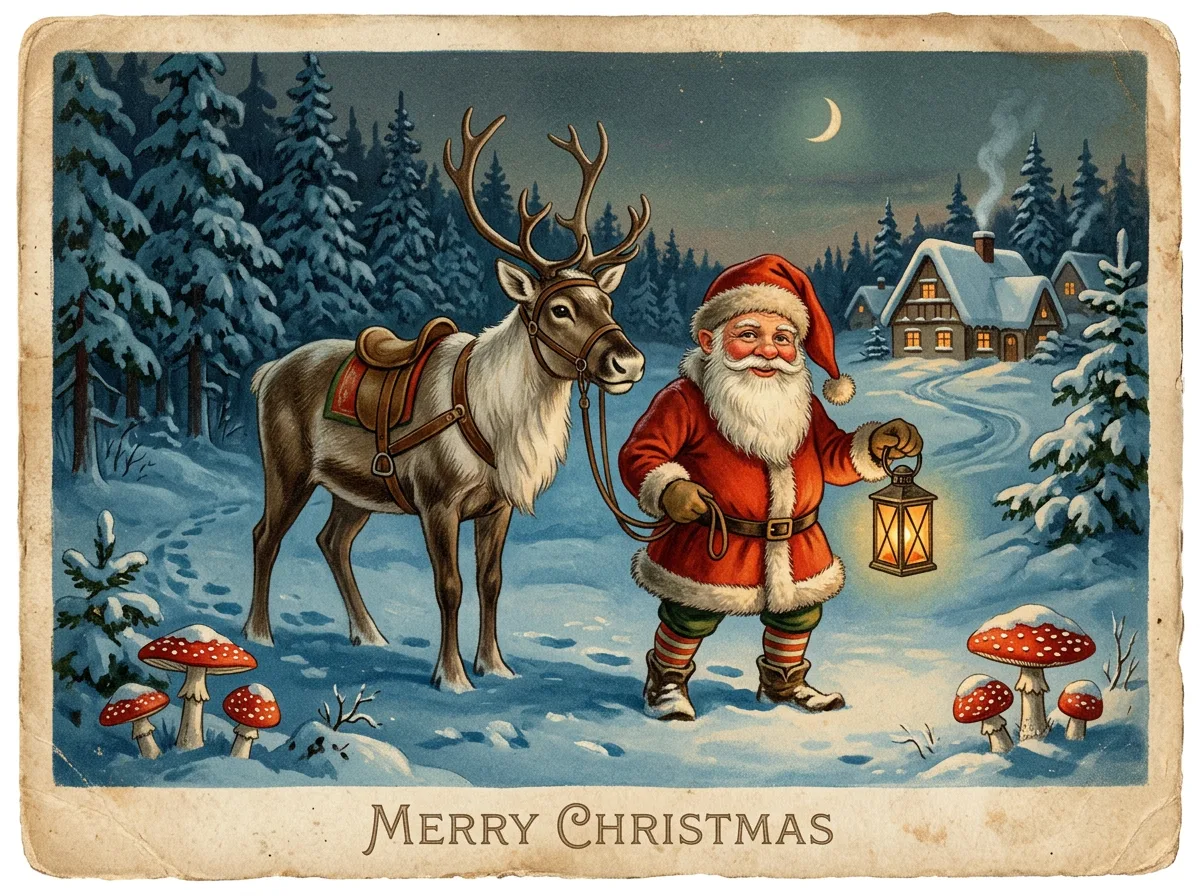
Was Santa a Mushroom? The red-and-white theory, weighed
Flying reindeer, a red-and-white visitor, gifts through the smoke-hole: the famous theory that Santa Claus is a folk memory of the fly agaric - and what folklorists actually say.
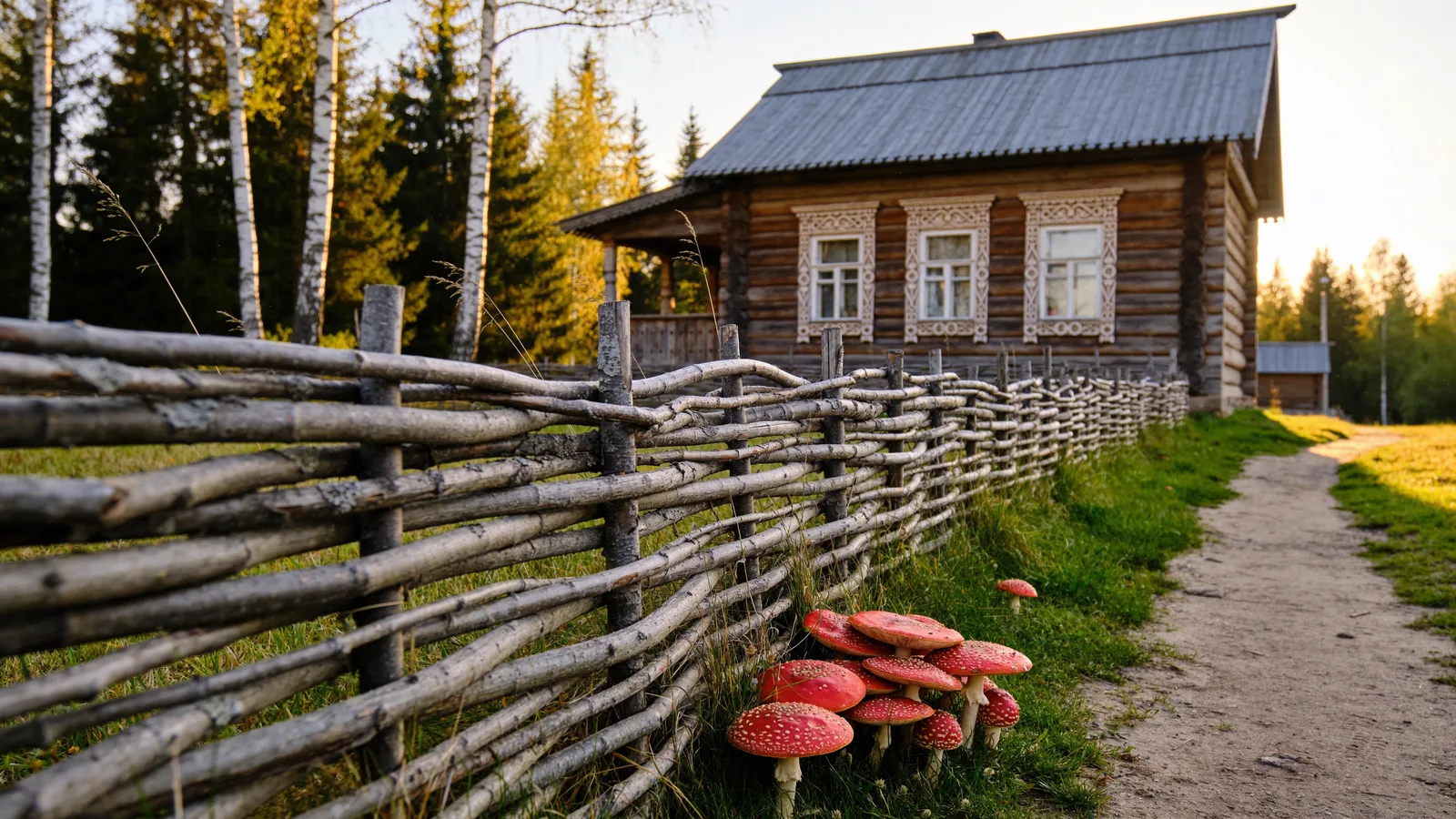
Baba's Forest - Slavic whispers
Мухомор: the fly-killer at the window, the trickster of the fairy tale, and the red cap that Slavic folk art never stopped painting.
botanical specimen · not for consumption · 19+