From Mario to the Mushroom Emoji 🍄, how the fly agaric conquered pop culture
A power-up, a Smurf village, a keyboard glyph on two billion phones: why the one mushroom everyone can draw is Amanita muscaria, and nobody notices.
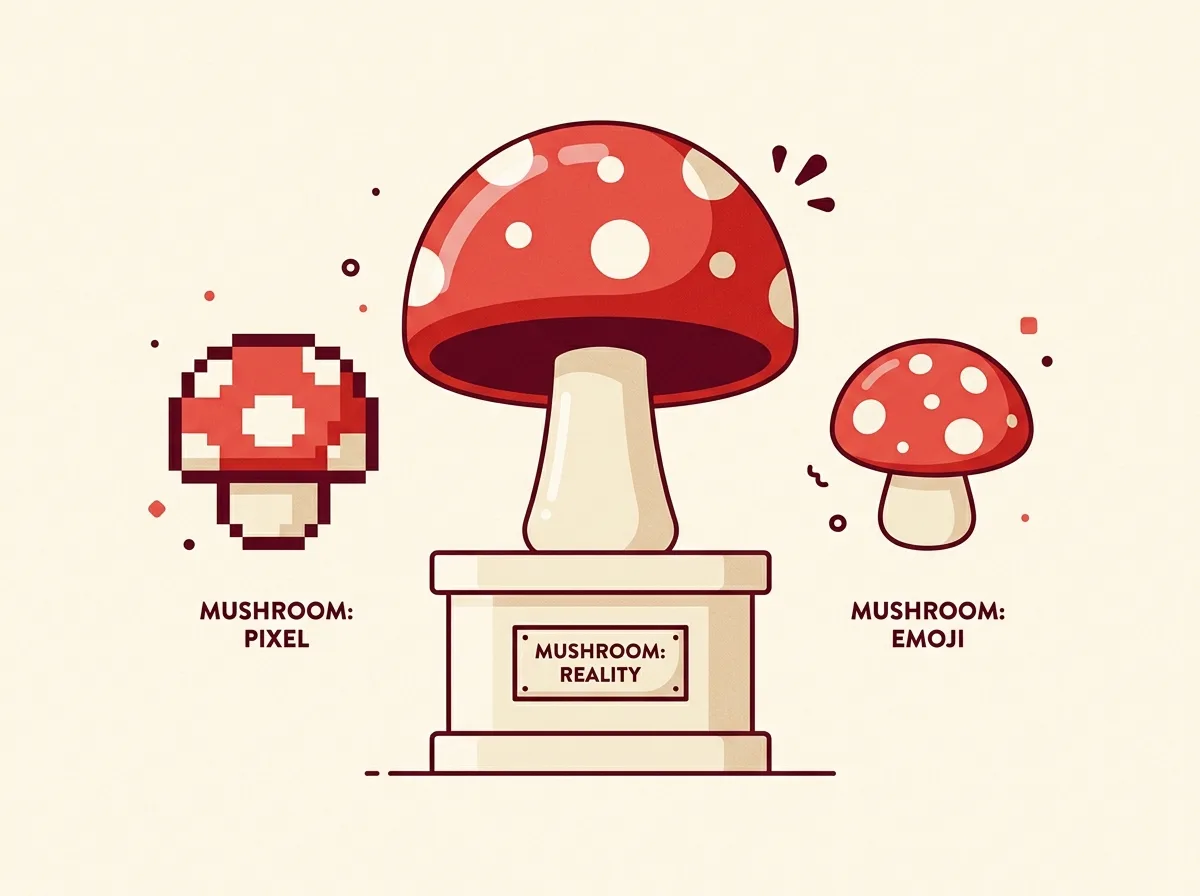
Editorial illustration comparing a real red fly agaric, a pixel-art game mushroom and the mushroom emoji
TL;DR
- The red-with-white-spots mushroom in games, cartoons and emoji sets is visually Amanita muscaria, the fly agaric, in every case.
- The lineage runs Victorian fairy-tale illustration → Smurf houses (1958) → Mario’s Super Mushroom (1985) → the Unicode 🍄 glyph (2010).
- It won because it is the only mushroom that survives being drawn at 16 pixels: dome, contrast, spots.
- Fame is not safety - raw caps are toxic (ibotenic acid), and the real thing stays behind glass: dried fly agaric caps as botanical specimens. 19+.
The most-drawn mushroom on earth
Ask anyone to draw a mushroom. You will get a red dome with white spots - never a chanterelle’s ruffle, never a porcini’s tan cushion. The world’s default mushroom is a species most people have never knowingly seen and could not name: Amanita muscaria.
That default did not appear by accident. It was installed, one illustration at a time, over roughly 160 years.
The chain of custody
1865 - Wonderland. John Tenniel puts Alice’s caterpillar on a domed toadstool, and «mushroom = magic + size-change» enters the English visual language for good, as the church-and-parlour story traces in detail.
1958 - the village. Peyo houses the Smurfs in red-capped, white-spotted mushrooms. A generation of European children learns the shape before they learn to read.
1985 - the power-up. Nintendo needs an object that means «grow» and reads clean in a handful of pixels. The Super Mushroom is red, spotted, and, the designers have said as much about the fairy-tale lineage, descended from exactly the same illustrations. Growth, in a game, because growth in a story, because a caterpillar, because a fresco painter’s forest.
2010 - the keyboard. Unicode adds 🍄. Every vendor draws the same species. There is now a fly agaric on approximately every phone on the planet.
Why this one won
Icon design is brutal: whatever cannot survive extreme reduction dies. The fly agaric happens to be built for it - a symmetrical cap with maximum colour contrast and discrete high-contrast spots, all still legible when the whole organism is sixteen pixels tall. Add that it is unmistakable in a photograph and impossible to confuse with lunch, and you have the perfect graphic mushroom.
The irony is complete: the most recognizable mushroom in the world is one you must never eat. It became a symbol of nourishment in games precisely because in life it is the opposite - beautiful, memorable, and off-limits.
The original, in the flesh
That is the version we keep: not the sprite, the source. Wild Amanita muscaria from the Coast Mountains of British Columbia, dried and vacuum-sealed or stone-milled to a light-ochre powder, sold as botanical specimens for collection and study. Same red, same white flecks, no extra lives - just the actual mushroom behind all the pixels.
Botanical specimen · not for consumption · 19+. Fresh Amanita muscaria is toxic - a raw cap is loaded with ibotenic acid, which careful drying and curing convert largely into muscimol.
Questions, answered
Is the Super Mario mushroom really a fly agaric?
It is the same visual DNA - a red cap with white spots. Nintendo's design lineage runs through Alice in Wonderland and European fairy-tale illustration, both of which drew the fly agaric; the game never names a species, but the ancestor is unmistakable.
Is the 🍄 emoji an Amanita muscaria?
Yes, in every major vendor's artwork: red cap, white spots, pale stem. When a billion keyboards need one mushroom, they all draw this one.
Why this mushroom and not a chanterelle or porcini?
Because it is the only one that reads instantly at 16 pixels. High contrast, symmetrical dome, distinct spots - it survives extreme simplification, which is exactly what icons, sprites and children's books require.
Does its fame make it safe?
No - the opposite lesson. It is famous because it is beautiful and dangerous. Fresh Amanita muscaria is toxic - a raw cap is loaded with ibotenic acid, which drying and curing convert largely into muscimol; we offer it as a botanical specimen for collection and study only. 19+.
Sources & further reading
botanical specimen · not for consumption · 19+