How to Store Dried Amanita Muscaria - an archivist's guide
Air, light, heat and humidity are the four thieves of a dried specimen. Here is how a fly agaric cap keeps its brick-red colour and its structure for years.
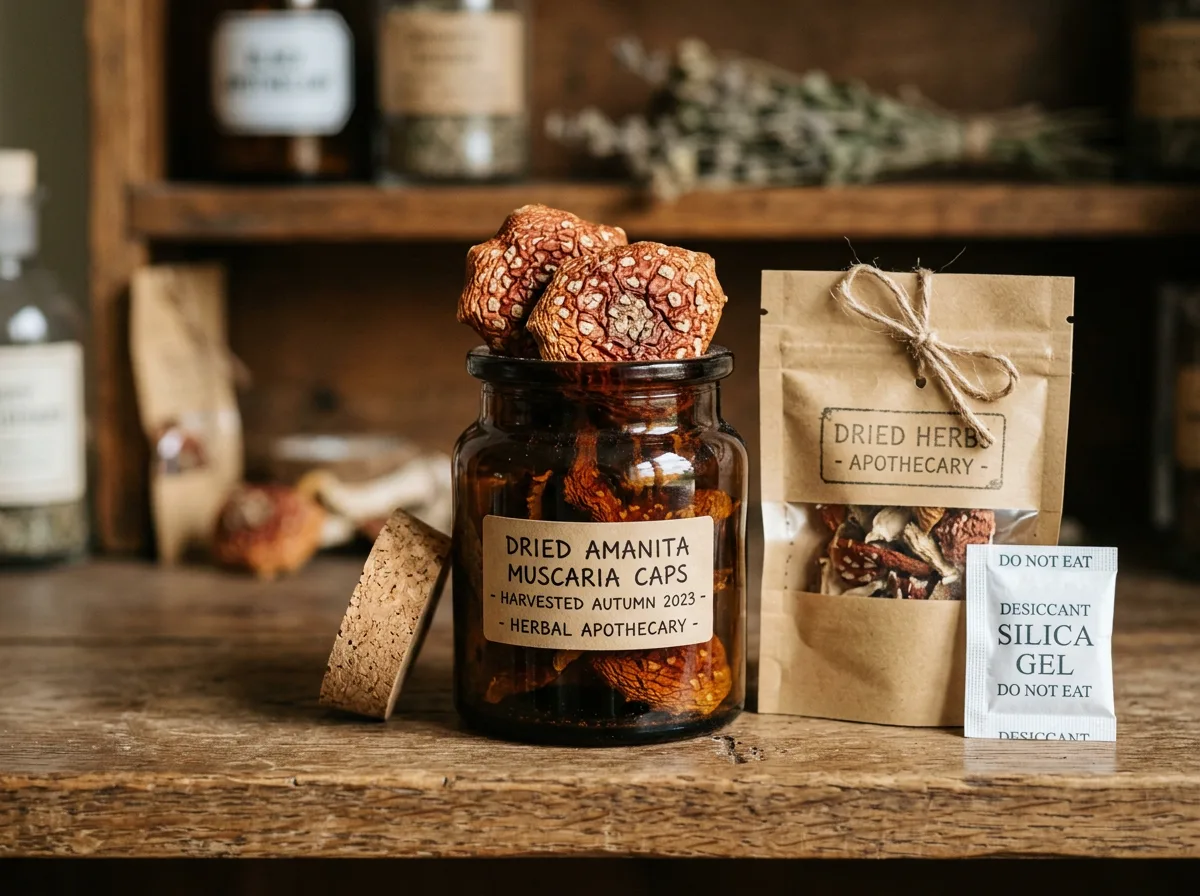
Dried Amanita muscaria caps in an amber jar and kraft pouch with a desiccant sachet on a wooden shelf
TL;DR
- Airtight, dark, cool, dry - in that order of importance. Everything else is detail.
- Leave the vacuum pouch sealed until you need the specimen; after opening, move to an amber or opaque airtight jar with a silica sachet.
- No fridge, no freezer, no sunny shelf: condensation and UV do more damage than years do.
- Test by feel - a good dried cap is paper-light and snaps; anything leathery has drunk moisture from the room.
- Our caps arrive already dried at 40 °C with a brief 90 °C finish, cured and sealed: dried Amanita muscaria caps and stone-milled powder. Botanical specimen · not for consumption · 19+.
Why storage decides everything
A dried mushroom is a stable object with one weakness: it is hygroscopic. Left in ordinary room air, a paper-light cap will slowly pull moisture back out of the atmosphere until it is leathery - and once water activity rises, mould has an opening. Everything below is about keeping that number low and steady.
The good news: the hard work is already done before the specimen reaches you. Our caps are dried for 36 hours in 40 °C moving air, finished with a brief rise to 90 °C so residual ibotenic acid converts to muscimol, then cured in the dark for weeks and vacuum-sealed. Your job is only to not undo it.
The four thieves
Air. Oxygen fades pigment and carries moisture. Airtight is non-negotiable - the original vacuum pouch, or a jar with a real gasket.
Light. UV bleaches the scarlet toward dull brown faster than anything else on this list. Amber glass, an opaque tin, or simply a closed cupboard.
Heat. Warmth accelerates every chemical process in the cap. A cool interior wall beats a kitchen shelf above the stove; anywhere that stays under ~20 °C is fine.
Humidity. The quiet killer. A single silica sachet in the container does more than any other accessory. In a damp climate, replace or dry the sachet twice a year.
A practical setup
For a collection you actually open: an amber jar with a screw gasket, one silica sachet, a small label with species and harvest year, stored in a closed cupboard away from the kitchen. For long-term archive: leave the vacuum seal intact, that is what it is for, and store the pouch flat in a drawer.
If you are milling or handling powder, work quickly and reseal: fine grind takes on humidity in minutes, not hours, because of its surface area.
Reading a specimen
Pick a cap up. It should feel absurdly light for its size and snap cleanly at the edge. The red should still be brick-red - muted, not brown; browning usually means either scorched drying or a season on a bright shelf. A faint earthy-sweet smell is normal; musty or sharp is not.
Well-kept, a specimen outlives the interest of whoever bought it. That is the whole idea behind an archive rather than a pantry: the mushroom stays exactly what it is, indefinitely, available in any weight from 20 to 500 g and going nowhere.
Botanical specimen · not for consumption · 19+. This is preservation guidance for study material only; fresh Amanita muscaria is toxic - a raw cap is loaded with ibotenic acid, which careful drying and curing convert largely into muscimol.
Questions, answered
How long do dried Amanita muscaria caps keep?
Kept airtight, dark, cool and dry, a properly dried specimen holds colour and structure for several years. The limiting factor is almost never time - it is humidity and light.
Do I need a fridge or freezer?
No. Cool room temperature is ideal; a fridge introduces condensation every time the container is opened, which is exactly what you are trying to avoid. Freezing is unnecessary for dried material.
Should I keep the vacuum pouch sealed or move the caps to a jar?
The sealed pouch is the best long-term home. If you want to display or handle specimens, an amber or opaque airtight jar with a silica sachet is the next best thing - and keep it out of direct sun.
How do I know if a specimen has gone bad?
Trust texture and colour: caps should stay paper-light and snap rather than bend. Softness or leathery flex means absorbed moisture; dark browning or musty smell means it was stored damp. Discard anything showing mould.
Does storage advice differ for powder?
Powder has far more surface area, so it takes on moisture faster. Keep it in its sealed pouch or a small airtight jar with a desiccant, and open it as rarely as possible.
Sources & further reading
botanical specimen · not for consumption · 19+