Amanita muscaria & its look-alikes, a field ID guide
How to recognize the fly agaric with confidence, and how to tell it from the caps that copy its colour, a botanist's checklist, not a forager's.
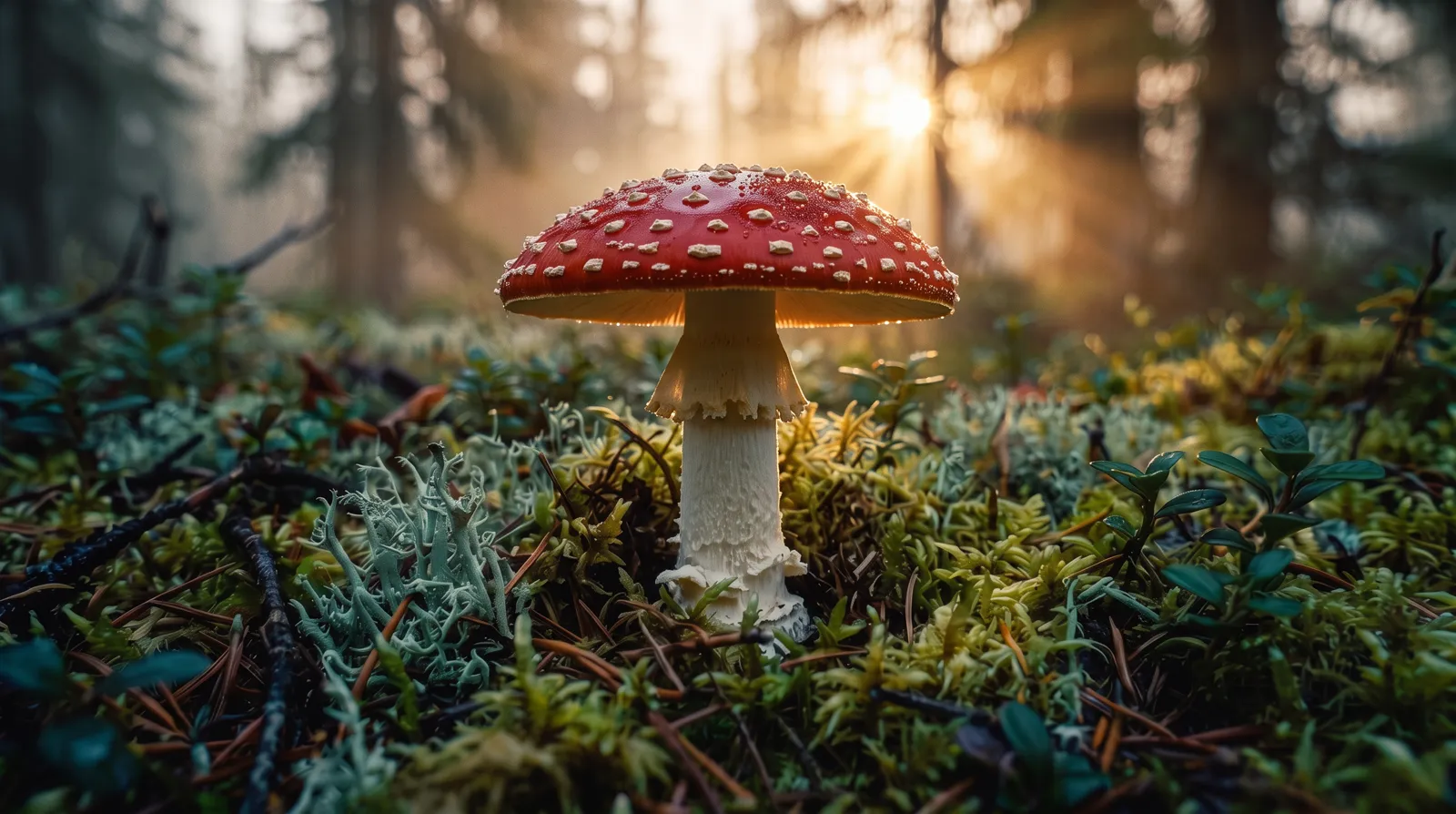
Mature Amanita muscaria at dawn showing red cap, white warts and ringed stem - film still
TL;DR
- Identify by the combination, never one trait: red-orange cap, removable white warts, white gills, white spore print, a stem ring, and a bulbous base with concentric scaly rings.
- Rain can strip the warts and North American forms can be orange or yellow - cap colour alone is a trap.
- The dangerous confusions are within genus Amanita, which also contains the lethal destroying angels and death cap. Treat every white-gilled, ringed, bulbous-based mushroom with respect.
- This is a recognition guide for study. Botanical specimen · not for consumption · 19+.
Read the whole mushroom, not the cap
Every year someone identifies a mushroom by its most photogenic feature and gets it wrong. Amanita muscaria is famous for a scarlet cap dotted with white - and that image, taken alone, is the least reliable way to name it. The warts wash off in rain. The scarlet fades to orange with age and sun. And across North America the species is really a complex, with a yellow-orange form (often called var. guessowii or formosa) that looks nothing like the storybook picture.
Confident identification is a checklist read top to bottom, on a whole specimen lifted intact from the ground - base and all.
The six-point check
1 · Cap. 8–20 cm, scarlet to orange (sometimes yellow in North American forms), sticky when wet, drying to a shine. Scattered white to pale-yellow warts that rub off easily - pyramidal remnants of the universal veil.
2 · Gills. Free from the stem, crowded, white - never yellow (that points to A. caesarea) and never pink or brown (that points elsewhere entirely).
3 · Spore print. White. Lay the cap gills-down on glass for a few hours. A print in any other colour rules the species out immediately - this is the cheapest, most decisive test in mycology.
4 · Ring (annulus). A skirt-like ring hangs on the upper stem - the torn remains of the partial veil that once protected the gills. It can collapse against the stem with age; look for its scar even if it has fallen.
5 · Stem. White, firm, tapering upward from a swollen base, often hollowing with age.
6 · Base (the decider). A bulbous base ringed with concentric scaly bands - the shattered universal veil. This is the fly agaric’s signature. It is also where its lethal cousins hide a smooth cup-like volva instead, so excavate the whole base gently and look.
The look-alikes worth naming
- Amanita caesarea (Caesar’s mushroom). Red-orange cap, but yellow gills, yellow stem, a smooth cap with no warts, and a prominent sac-like volva. The colours rhyme; the details do not.
- North American yellow-orange forms of A. muscaria. Not a different species so much as a different costume - same veil architecture, paler cap. Run the same six-point check.
- The dangerous relatives. The death cap (A. phalloides) and destroying angels (A. bisporigera and kin) share the genus’s ringed stem, white gills and bulbous, veil-wrapped base. They are not red - but the reason to learn Amanita anatomy properly is that this genus contains both the most recognizable mushroom on earth and the most deadly. Learn the base, learn the volva, learn the spore print, and you learn to be careful for life.
Where and when it fruits
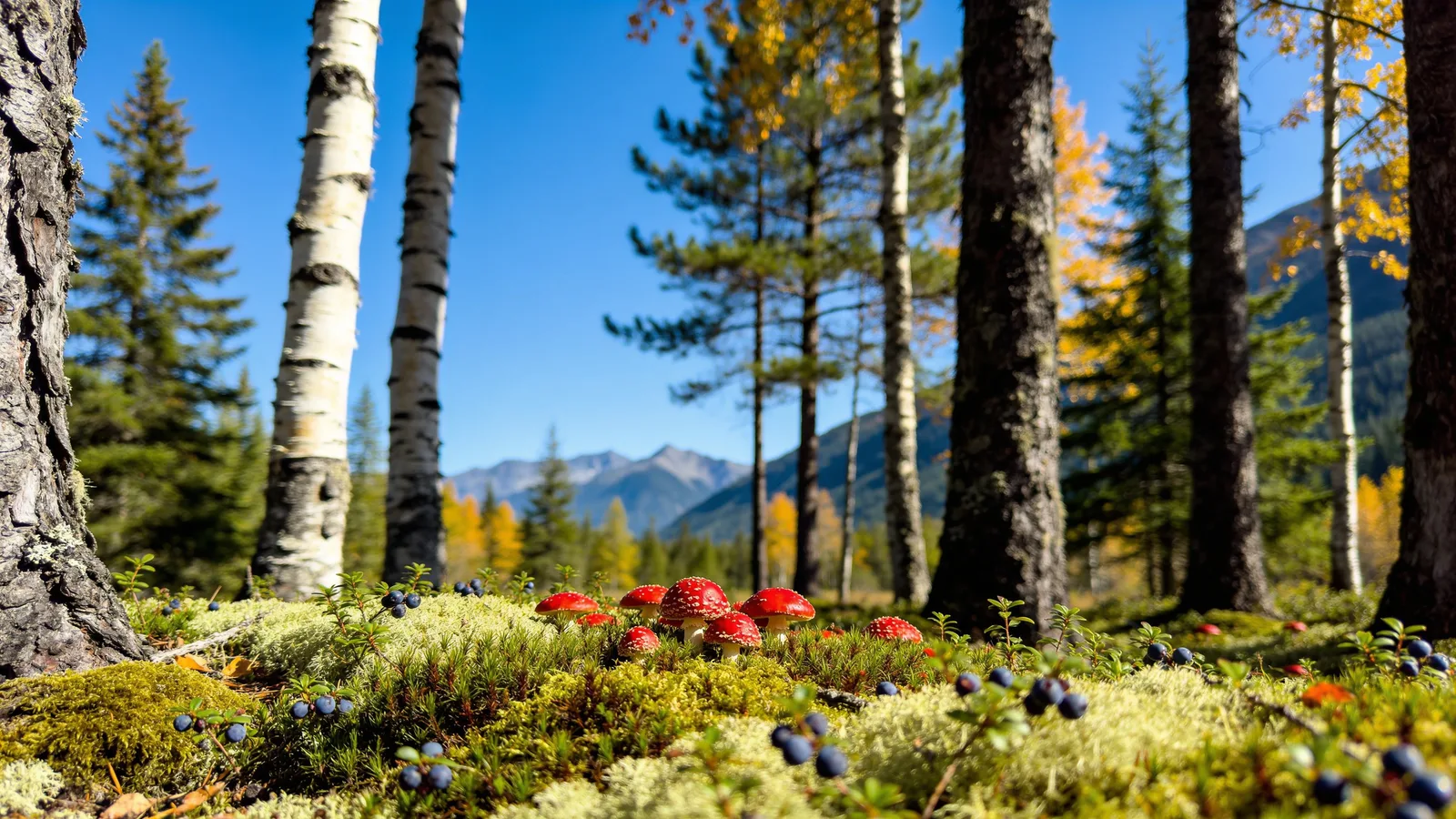
Amanita muscaria is mycorrhizal, it lives in partnership with tree roots, trading sugars for minerals, so you find it under birch, pine and spruce, from late summer into autumn, often at forest edges and along trails. In the Coast Mountains of British Columbia it rises after the first cold nights, exactly the window our film records. It does not grow on wood and it does not grow in deep shade far from a host tree; habitat itself is part of the identification.
The honest ending
A good field guide makes you slower, not bolder. Everything here is meant to help you recognize and record the fly agaric - to photograph it, print its spores, key it out, and leave it standing. What we seal into a sealed pouch, dried fly agaric caps you can buy in Canada from our collection, is the finished study object: brushed, dried, cured, and labelled for exactly what it is.
Botanical specimen · not for consumption · 19+. This article is for identification and study only; a fresh, raw cap is toxic, loaded with ibotenic acid, and the genus contains deadly species.
Questions, answered
What is the single most reliable feature of Amanita muscaria?
No single feature is enough - identification is the combination: a scarlet-to-orange cap with removable white warts, white gills and spore print, a ring on the stem, and a bulbous base ringed with concentric scaly bands (the remains of the universal veil). Check all of them together.
What is most often confused with the fly agaric?
Young Amanita caesarea (Caesar's mushroom) has a red-orange cap but yellow gills, a yellow stem and no warts. In North America, Amanita muscaria is itself a species complex with orange and yellow forms (var. guessowii/formosa) that trip up people expecting only scarlet.
Can rain wash away the white warts?
Yes - the warts are veil remnants sitting loosely on the cap and heavy rain can wash them off entirely, leaving a plain red cap. This is exactly why you never identify on cap colour alone.
Is this guide meant to help me forage Amanita muscaria to use?
No. It is written for recognition and study only. Fresh Amanita muscaria is toxic: a raw cap is loaded with ibotenic acid, which drying and curing convert largely into muscimol. And the genus Amanita includes the deadliest mushrooms known. Our specimens are botanical, not for consumption. 19+.
Sources & further reading
Keep reading
botanical specimen · not for consumption · 19+