Reindeer & Drum - Siberia's red cap
The steppe's oldest field note: how Koryak and Evenki tradition carried the fly agaric through winter, and why a red-and-white gift-giver still flies with reindeer.
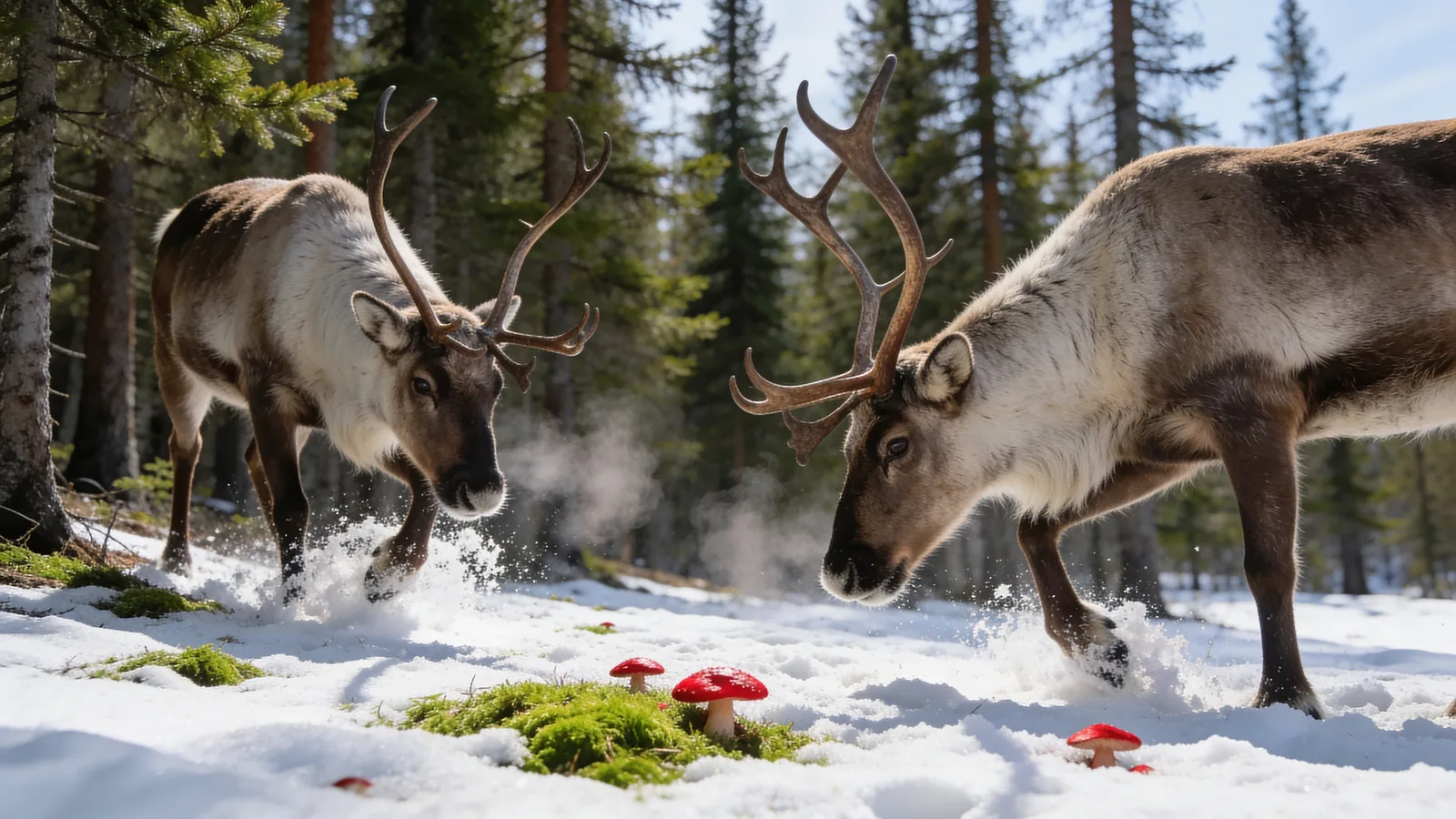
Reindeer digging through snow to reach red fly agaric mushrooms at the edge of the taiga, the wild Amanita muscaria we dry and sell in Canada
TL;DR
- The most detailed old records of people and fly agaric come from far-eastern Siberia, Koryak, Chukchi and Itelmen country, written down by ethnographers around 1900.
- In Koryak story-cycles the mushroom is a person: wapaq, a small spirit-people sprung where the god spat on the earth.
- Cliffs above the Pegtymel river in Chukotka carry two- to three-thousand-year-old carvings of figures with caps over their heads, which archaeologists named the mushroom-people.
- Reindeer genuinely dig for the red caps through snow; herd and mushroom share one winter economy and one mythology.
- The “Santa was a mushroom” theory is unproven and probably unprovable - but the colours, the chimney and the flying reindeer keep it evergreen.
- All of it is history and folklore, not instruction. Botanical specimen · not for consumption · 19+.
Where the wapaq came from
The Koryak story begins with a problem, the way the good ones do. Big Raven, Quikinn’a’qu, who made most of the world and is the reason the rest of it is the way it is, had caught a whale and could not get it home. He asked Existence, the being the Koryak call Vahiyinin, what to do. Existence spat on the earth, and where the spittle landed, small white things came up wearing red hats.
These were the wapaq. In the story they are not a plant. They are a people, small and particular, with their own opinions about who deserves their help, and they did what Big Raven asked. Afterwards he told them to stay on the earth and grow there forever, so his children would find them.
That is the whole shape of it, and the shape matters. In Koryak country the mushroom was never a thing you picked. It was a someone you met, who might or might not be in a good mood, and who was understood to have arrived on the earth before people did. The Russian ethnography that has kept working on this subject since the 1980s keeps returning to the same point: in the stories the fly agaric has spirits of its own, and the etiquette around it was etiquette toward a person.
The mushroom-people on the cliff
Long before anybody wrote any of that down, somebody carved it.
On the rock faces above the Pegtymel river, in the far north of Chukotka, there are engravings two to three thousand years old: reindeer, whales, bears, hunters in boats. And among them, figures that are not quite people. They stand with their arms spread and their knees bent, and over each head sits a large half-round cap, some of them fringed at the edge in the way a fly agaric is fringed. The largest of them all, about thirty-five centimetres tall, is a woman with two braids, and the cap sits on her like a second head.
The Magadan archaeologist N. N. Dikov worked on these carvings in the nineteen sixties and seventies. He consulted mycologists about the shapes, and the name he gave the figures has stuck ever since: люди-мухоморы, the mushroom-people. In the scenes the largest figures are usually the women, and they are usually in the middle.
What the carvings meant to the people who cut them is not recoverable. Nobody left a caption. But the resemblance to the wapaq of the Koryak stories, small red-capped persons who come to meet you, is close enough that the carvings and the storytelling have been read together for sixty years, across a gap of two millennia and several languages. Ours is not the only trade that keeps its records on stone longer than on paper.
The field note before field notes
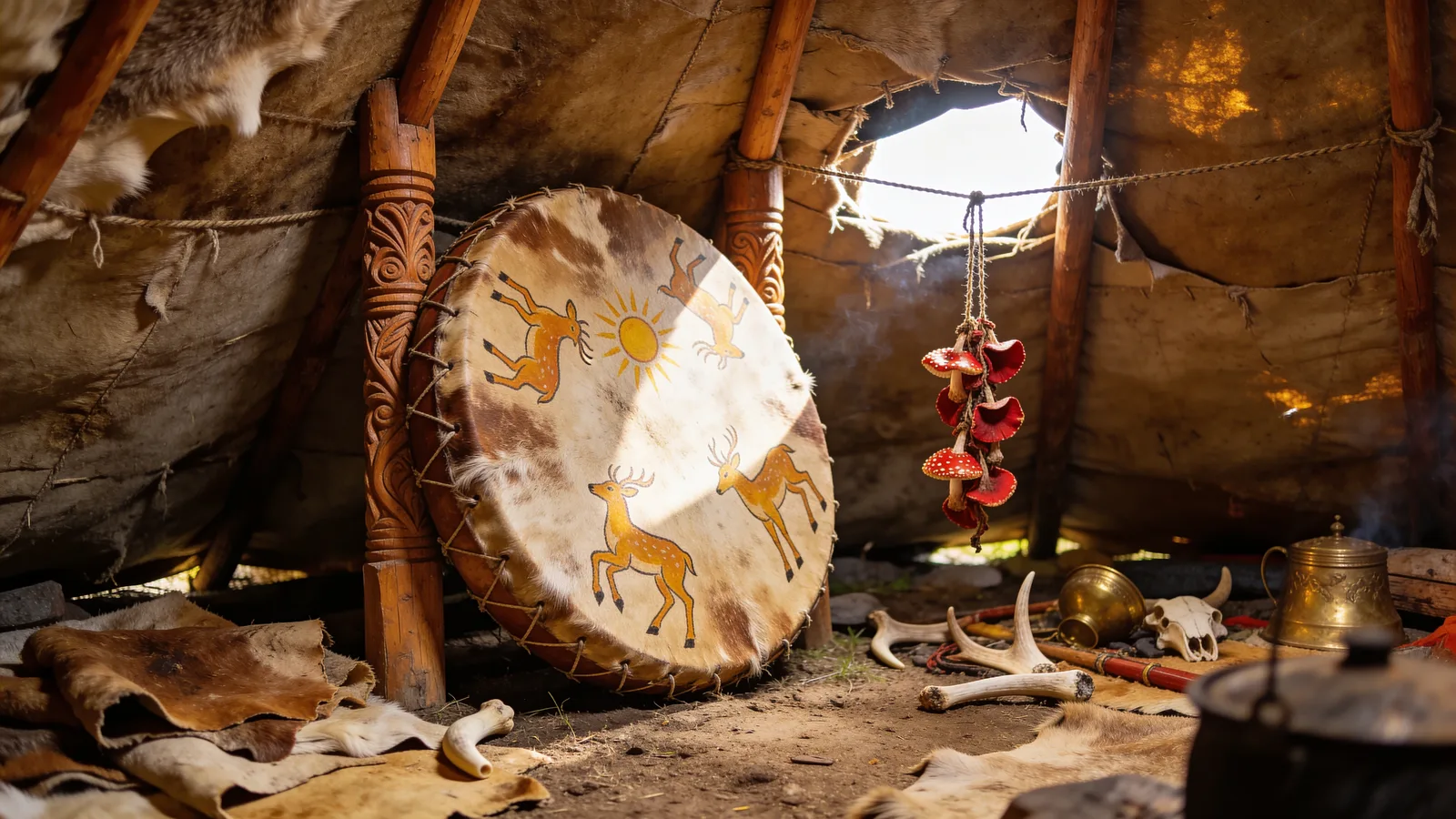
Long before mycology had a name, herders on the Kamchatka peninsula had a taxonomy of one: the red cap with white flecks that surfaced under birch and larch in August. When the Jesup North Pacific Expedition sent Waldemar Jochelson to live among the Koryak in 1900 and 1901, he wrote down what may be the oldest continuously held body of knowledge about Amanita muscaria (fly agaric, мухомор красный) anywhere: songs, trade values, taboos, and the origin story above. Bogoras was doing the same among the Chukchi at the same time. Both men filled volumes, both are still in print, and both are readable in full for free, which is more than can be said for most of what has been written about this mushroom since.
They also recorded the parts nobody quotes. That the wapaq were understood to be difficult. That there were rules about who, and when, and in what frame of mind, and that people were held to them. Every account we have from that country is an account of a practice hedged about with restrictions, which is the detail that gets lost when the subject reaches the internet.
We are not going to reproduce any of it here, and that is deliberate. This is a story about people who lived somewhere very cold a hundred and twenty years ago, told in a shop. Our own caps are dried Amanita muscaria specimens for collection and nothing else.
An economy written in antler
The ethnographies read like ledgers as much as legends. Bogoras, living with the Chukchi, noted that dried caps travelled inland along the same routes as iron kettles and tobacco, and that in scarce years a single specimen could be traded against a reindeer, a startling exchange rate that tells you what winter on the tundra values.
The reindeer themselves are shareholders. Herders across the taiga report the animals pawing through snow to reach the mushrooms, wobbling theatrically afterwards, and being followed by ravens who seem to know the routine. Biologists confirm the appetite is real. Folklore did what folklore does: it took an observed fact and braided it into the sky, reindeer that fly, sleighs that cross the night, a drum that beats like hooves on frozen ground.
The drum belongs to the same picture. In the taiga winter the tent is dark, the door is snowed shut, and the only opening to the sky is the smoke-hole above the fire. If you are telling a story about a journey to the upper world, that hole is the door your story has to use, because it is the only one there is. The architecture wrote the myth as much as the myth wrote itself.
The man in the red suit, examined politely
Which brings us to the theory everyone eventually asks about. It goes like this. A red-and-white figure, associated with reindeer, entering dwellings through the smoke-hole because the door is buried, carrying a sack, at solstice, is a folk memory of Siberian mushroom traditions, dried caps and all.
It is a beautiful pattern-match, and honesty requires the caveat: no folklorist has traced an unbroken line from Kamchatka to the North Pole. The modern Santa is documented as a blend of St. Nicholas, Dutch Sinterklaas, Victorian magazine art and twentieth-century advertising, none of which needed a mushroom to get where it got. The theory survives because the coincidences are too decorative to throw away, and because, like the berserker story, it makes the forest feel closer to the living room.
We file it under folklore about folklore and enjoy it there. It is a good story about how good stories get built, which is a more interesting subject than whether it is true.
From taiga to shield
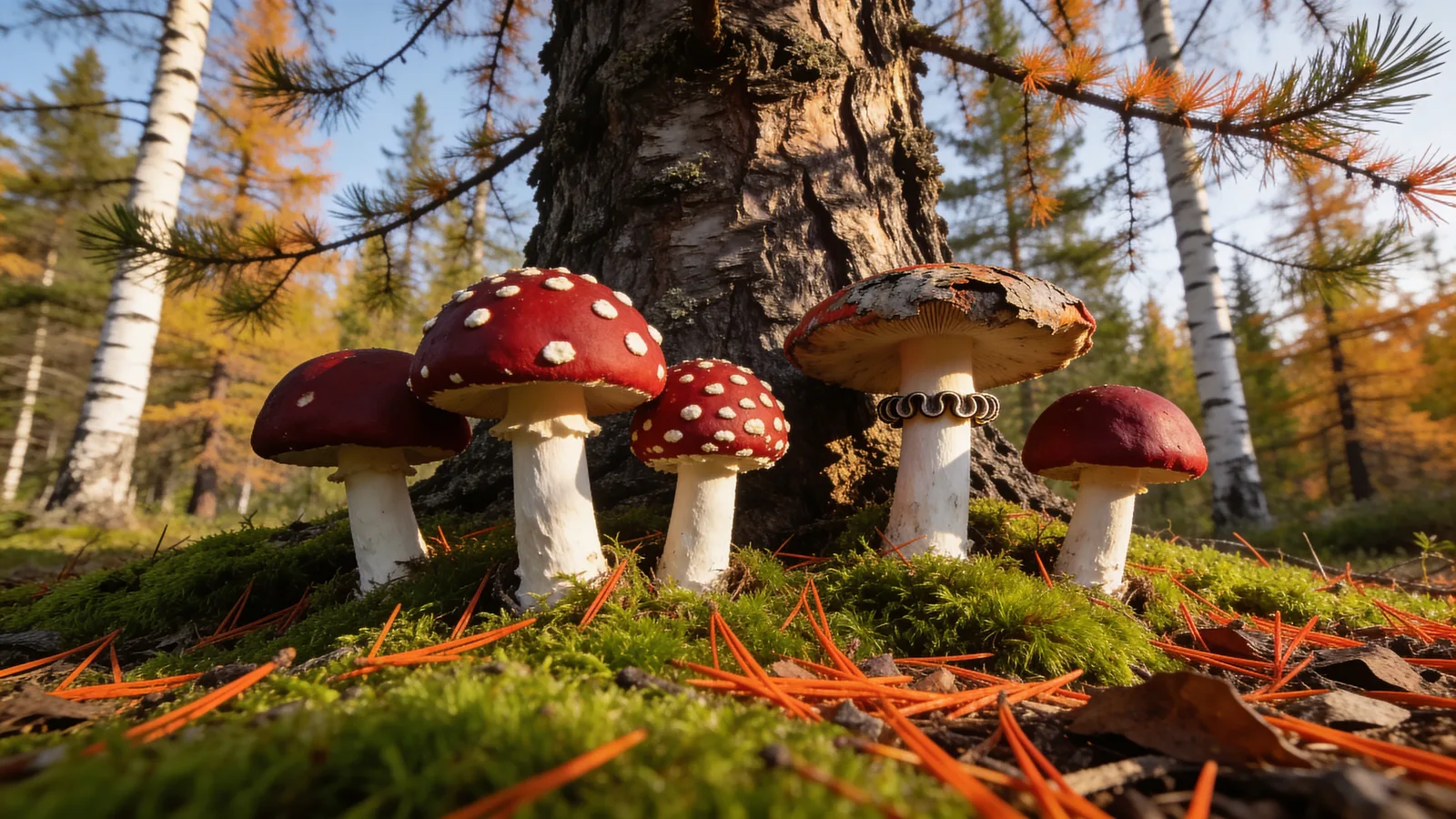
Kamchatka’s larch taiga and the conifer forest of the British Columbia coast are not the same forest. Nobody would confuse them: one is cold and open, ours is wet and closed and green to the ground. They grow the same mushroom anyway. The species the god’s spit called up comes up in our valleys every August, wearing the same red, keeping company with the same birches.
When we close a cap into a vacuum-sealed pouch we think about Jochelson’s notebooks, and about what he was actually doing there. He was writing names down. The point was never to use the wapaq. The point was to be able to say which one you were looking at, and to have it written somewhere after everyone who knew had died.
Today the same red travels by Canada Post instead of sled: wild-picked British Columbia caps, one dawn at a time, with a note in the box saying what they are and what they are not.
Botanical specimen · not for consumption · 19+. Folklore is not guidance and historical ethnography is not instruction; fresh Amanita muscaria is toxic - a raw cap is loaded with ibotenic acid, which careful drying and curing convert largely into muscimol.
Questions, answered
Which Siberian peoples have documented traditions around Amanita muscaria?
Ethnographers recorded practices among the Koryak, Chukchi, Itelmen and some Evenki and Khanty groups, mostly between the 17th and early 20th centuries. Waldemar Jochelson's and Waldemar Bogoras's fieldwork are the classic sources, and Russian-language ethnography has kept the subject alive since.
Do reindeer really seek out fly agaric?
Yes - herders have long reported reindeer digging through snow for the mushrooms, one reason the animal and the fungus are intertwined in taiga folklore.
What are the Pegtymel petroglyphs?
Rock carvings on cliffs in far northern Chukotka, roughly two to three thousand years old, showing human figures with large caps over their heads. The archaeologist N. N. Dikov called them 'mushroom-people'. The largest figure, about 35 cm tall, is a mushroom-woman with two braids.
Is the Santa Claus connection proven?
No. The red-and-white gift-bringer with flying reindeer is a suggestive modern theory, popularized in the 20th century, and most folklorists consider it speculative. We tell it as a story about a story.
Does ShroomsBloom sell Amanita muscaria for the uses described in ethnographies?
No. Historical ethnography is history, not instruction. Fresh Amanita muscaria is toxic - a raw cap is loaded with ibotenic acid, which drying and curing convert largely into muscimol; our pouches are botanical specimens for collection and study only. 19+.
Sources & further reading
- Waldemar Jochelson, 'The Koryak' (Jesup North Pacific Expedition, vol. 6) - full scans
- 'Koryak Texts' (1917) - the myth cycle in full, free scan
- Waldemar Bogoras, 'The Chukchee' (AMNH, 1904-1909)
- Е. П. Батьянова, М. М. Бронштейн. Мухомор в быту, верованиях, обрядах, искусстве народов Севера // Сибирские исторические исследования, 2016
- К. А. Сагалаев. Ритуальное использование мухоморов у современных коряков // Томский журнал лингвистических и антропологических исследований, 2022, вып. 3
- «По тропе мухоморов к истокам шаманизма» - пегтымельские петроглифы и «люди-мухоморы» Н. Н. Дикова
- Santa Claus and Amanita muscaria - the debated theory
Keep reading
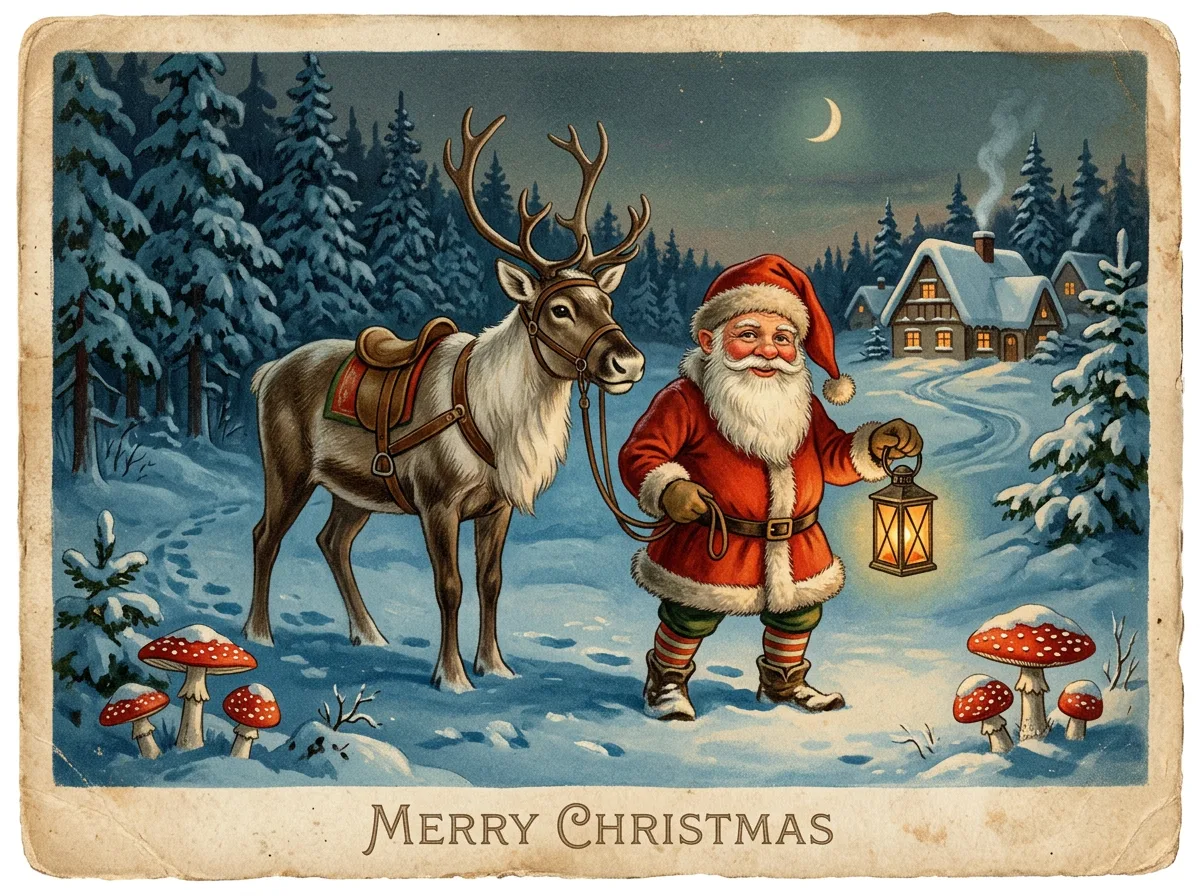
Was Santa a Mushroom? The red-and-white theory, weighed
Flying reindeer, a red-and-white visitor, gifts through the smoke-hole: the famous theory that Santa Claus is a folk memory of the fly agaric - and what folklorists actually say.
Baba's Forest - Slavic whispers
Мухомор: the fly-killer at the window, the trickster of the fairy tale, and the red cap that Slavic folk art never stopped painting.
botanical specimen · not for consumption · 19+