SPECIMEN № 001 · 50 GRAMS
50 g Dried Caps
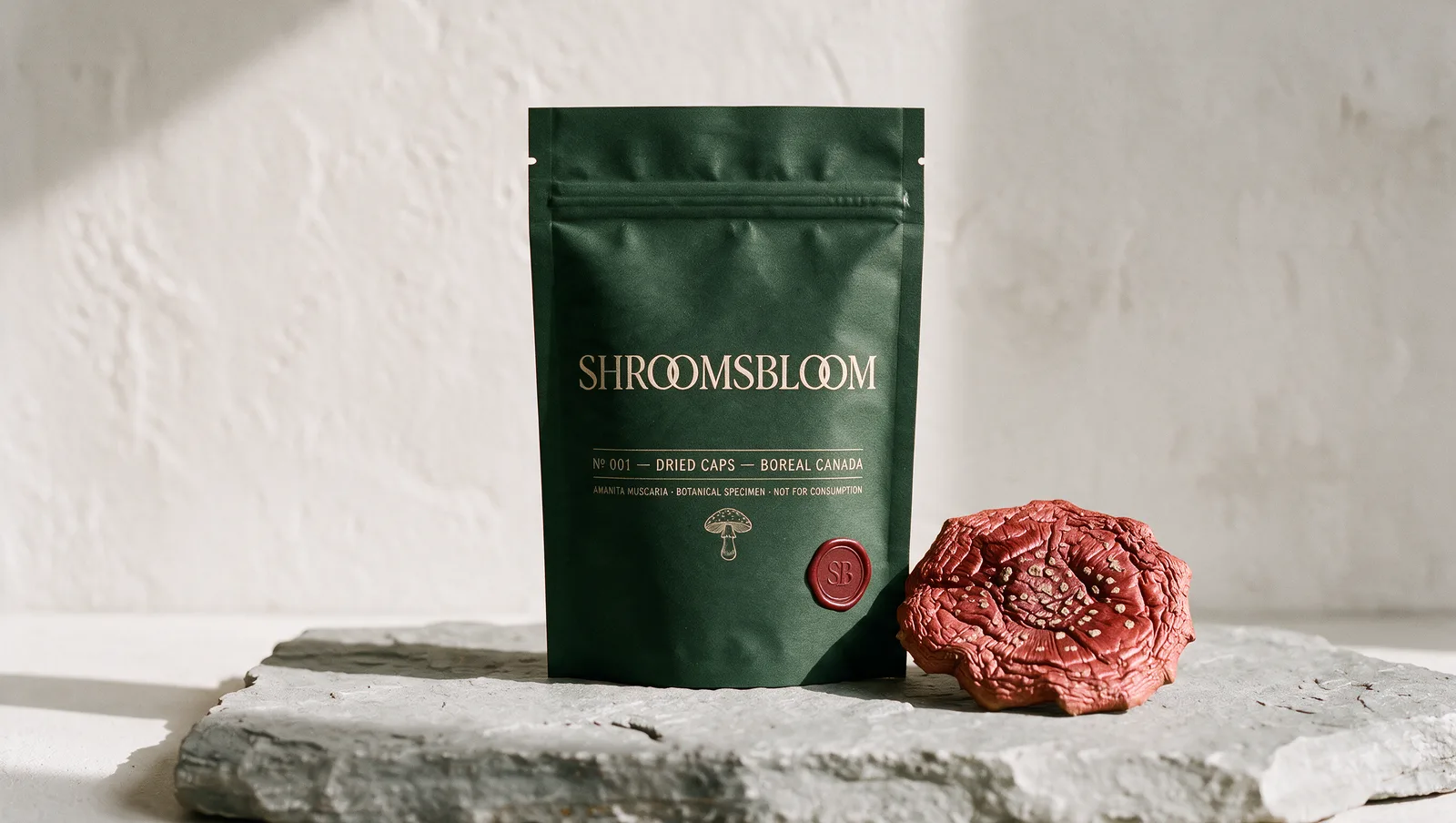
50 grams of wild Amanita muscaria (fly agaric), roughly 16 whole dried caps, gathered in the forests of British Columbia.
Prefer a different amount? Any weight from 30 to 500 g can be ordered on the main dried caps page - drag the scale or type the exact grams.
Sixteen caps to a 50 g pouch
Around 16 caps, though the number depends entirely on what came out of the dryer that week. This is the size where a pouch stops being one specimen and becomes a set: enough caps in front of you to see how far the species varies inside a single forest, from buttons the width of a thumbnail to crowns you need two fingers to lift.
Crowns do not go down a narrow neck
A pouch of 16 is the first one that has to be put somewhere, and the shape of the container decides more than how much it holds. A broad crown is wider than the mouth of most kitchen jars. Wide and shallow works, crowns lying flat on their backs with the buttons filling in around them. Tall and narrow does not: a dried cap snaps rather than bends, so whatever you press down a narrow neck arrives at the bottom in pieces.
C$ 1.72 / g, and why
C$86 works out at C$ 1.72 / g. Against the 30 g pouch at C$ 1.90 / g that is roughly 9% off every gram. The step after this one, 100 g at C$149, takes another 13% off and lands the gram at C$ 1.49 / g.
Set the five sizes side by side and the gram falls from C$ 1.90 / g at the smallest pouch to C$ 1.12 / g at the largest. By 50 grams it has covered about 23% of that distance.
Getting it there
C$86 leaves C$64 to go before the C$150 line, so the parcel is the flat C$21 tracked service at 2–8 business days, or C$32 by Xpresspost at 1–3 business days. One price to Nunavut, one price to Ontario. Payment that clears before 6 pm Vancouver time goes to the post office the same day.
If that line is what you are aiming at, this pouch and a 30 g one together come to C$143 and stop C$7 short of it. Two of these clear it.
The 36 hours behind this pouch
The caps were brushed clean* rather than washed, parted from their stems, then dried for 36 hours in 40 °C moving air with a brief rise to 90 °C at the end. After that they were vacuum-sealed and left three months in a dark room until the colour settled into brick red.
The seal is what keeps that colour. Our notes on storage go through what actually degrades a dried cap once the pouch is open.
* No cap comes out of a forest perfectly clean, and a brush only gets so far. Expect the odd spruce needle, a fragment of dry leaf or a little soil in the pouch. We do not wash them: washing would put back the water the dryer spent 36 hours taking out.
Anything sold for people to eat falls under Canada's food and natural health product rules, which is why this is sold as a botanical specimen instead.
Questions about 50 g
How many caps is 50 g?
Around 16. Real caps run 1 to 30 g each, so the number shifts from pouch to pouch while the weight does not.
What does a 50 g order arrive in?
A vacuum-sealed pouch or a rigid box, closed the week the caps left the dryer, inside a plain courier envelope with no branding on it.
How much does 50 g save against 30 g?
About 9% per gram: C$ 1.72 / g here, C$ 1.90 / g at 30 g. The caps are drawn from the same batch either way.
Does 50 g reach free shipping?
Not on its own. C$86 is C$64 short of the C$150 line, so the tracked parcel is C$21.
How long does a 50 g parcel take?
2–8 business days by tracked parcel, 1–3 business days by Xpresspost, counted from the day it goes out.
Where should 50 g be kept?
In the pouch it came in, out of the light and away from damp. Once opened, an airtight jar in a cupboard.